<?xml version="1.0" encoding="UTF-8"?><feed
	xmlns="http://www.w3.org/2005/Atom"
	xmlns:thr="http://purl.org/syndication/thread/1.0"
	xml:lang="en-GB"
	>
	<title type="text">Humane Future of Work</title>
	<subtitle type="text">Building a better future, one person at a time.</subtitle>

	<updated>2024-05-14T16:10:04Z</updated>

	<link rel="alternate" type="text/html" href="https://humanefutureofwork.com/" />
	<id>https://humanefutureofwork.com/feed/atom/</id>
	<link rel="self" type="application/atom+xml" href="https://humanefutureofwork.com/feed/atom/" />

	
	<entry>
		<author>
			<name>Iker Urrutia</name>
					</author>

		<title type="html"><![CDATA[New adventure, new business, new website, new newsletter!]]></title>
		<link rel="alternate" type="text/html" href="https://humanefutureofwork.com/new-adventure-new-business-new-website-new-newsletter/?utm_source=rss&#038;utm_medium=rss&#038;utm_campaign=new-adventure-new-business-new-website-new-newsletter" />

		<id>https://humanefutureofwork.com/?p=4114</id>
		<updated>2024-05-14T16:10:04Z</updated>
		<published>2024-05-14T16:10:00Z</published>
		<category scheme="https://humanefutureofwork.com/" term="Personal Growth" />
		<summary type="html"><![CDATA[<p>Photo by Steven Coffey on Unsplash I am going solo, and I am nervous but also more excited than ever. I finally took the jump. I am not&#8230;</p>
<p>The post <a href="https://humanefutureofwork.com/new-adventure-new-business-new-website-new-newsletter/">New adventure, new business, new website, new newsletter!</a> appeared first on <a href="https://humanefutureofwork.com">Humane Future of Work</a>.</p>
]]></summary>

					<content type="html" xml:base="https://humanefutureofwork.com/new-adventure-new-business-new-website-new-newsletter/?utm_source=rss&#038;utm_medium=rss&#038;utm_campaign=new-adventure-new-business-new-website-new-newsletter"><![CDATA[
<p>Photo by <a href="https://unsplash.com/@steeeve?utm_content=creditCopyText&amp;utm_medium=referral&amp;utm_source=unsplash">Steven Coffey</a> on <a href="https://unsplash.com/photos/man-walking-on-grass-covered-ground-_Q4v8_Iy0rA?utm_content=creditCopyText&amp;utm_medium=referral&amp;utm_source=unsplash">Unsplash</a></p>


<h2 class="wp-block-heading" id="h-i-am-going-solo-and-i-am-nervous-but-also-more-excited-than-ever"><strong>I am going solo, and I am nervous but also more excited than ever</strong>.</h2>


<p>I finally took the jump. I am not sure if there will be a safety net waiting for me if I fall, but I had to take this jump.</p>


<p>I have been planning to do this for years, but I haven’t found the courage to do it until now. Since I trained as a coach in 2018, I have wanted to set up my own business, be my own boss, and make a living by helping others. I didn’t have the courage before, but I do now.</p>


<p>The company I worked for, Sodexo, didn’t make things easy, and I mean it in a good way. It is a great company with amazing people, and every time I was about to make this jump, a new exciting opportunity would arise within Sodexo. I could never say no, so I would postpone my decision a bit longer.&nbsp;</p>


<p>Even in my last stint as a Global Talent Director, I was doing something I loved with a fantastic team and manager, with a lot of autonomy and flexibility. What was there not to like?</p>


<p>And yet, I had to take this jump.</p>


<p>It was something coming from inside me. I really needed to do this, or I knew I would regret it for the rest of my life. As&nbsp;<a href="https://www.goodreads.com/quotes/1135671-in-the-end-we-only-regret-the-chances-we-didn-t#:~:text=Quote%20by%20Lewis%20Carroll%3A%20%E2%80%9CIN,we%20didn'...%E2%80%9D" target="_blank" rel="noreferrer noopener">Lewis Carroll said</a>, “In the end… we only regret the chances we didn’t take, the relationships we were afraid to have, and the decisions we waited too long to make.”&nbsp;</p>


<p>I had to take this chance.</p>


<p>You have to try things, especially if they come from within yourself and are a manifestation of&nbsp;<a href="https://ikerurrutia.com/blog/how-to-find-your-career-purpose-in-four-simple-steps/" target="_blank" rel="noreferrer noopener">your purpose</a>. You may fail trying, but you need to try anyway. That’s the only way you’ll know what it was like. That’s the only way you’ll know whether it was worth trying.&nbsp;</p>


<p>That’s the only way not to regret it when&nbsp;<a href="https://ikerurrutia.com/blog/happy-life-secrets-from-the-dying/" target="_blank" rel="noreferrer noopener">you are on your deathbed</a>&nbsp;forty or fifty years later.&nbsp;</p>


<h2 class="wp-block-heading" id="h-my-business"><strong>My business</strong></h2>


<p>I will now be working as a full-time coach and trainer.&nbsp;</p>


<p>I will provide individual executive coaching, team coaching, and training. I want to help leaders grow and become&nbsp;<a href="https://ikerurrutia.com/blog/the-wise-leader/" target="_blank" rel="noreferrer noopener">wiser</a>, more effective and&nbsp;<a href="https://ikerurrutia.com/blog/the-purposeful-leader-5-essential-characteristics-to-be-one/" target="_blank" rel="noreferrer noopener">purposeful</a>.</p>


<p>I love coaching, so I want to do more of it. I have coached tens of leaders in Sodexo, and I am grateful to the company and all the coachees I have worked with over the years for trusting me and allowing me to do so.&nbsp;</p>


<p>I also enjoy designing and delivering training, so&nbsp;I will do this, but only on topics related to my core mission of helping leaders grow and become wiser, more effective and purposeful. I’ll train people on leadership, personal growth, emotional intelligence, creativity, and the like.&nbsp;</p>


<h2 class="wp-block-heading" id="h-a-new-newsletter-a-new-web"><strong>A new newsletter, a new web</strong></h2>


<p>Another thing I love doing is writing, so I want to do more of it as well.&nbsp;</p>


<p>Every week, I will write a long post on leadership, coaching, personal growth, purpose, or the future of work. I will also write shorter posts related to the same topic. I will include them all in a weekly newsletter I will send subscribers.&nbsp;</p>


<p>This newsletter will&nbsp;be called&nbsp;<strong>Coaching for Wisdom Leadership</strong>. Wisdom is an all-encompassing concept that alludes to good judgement and decision-making but also to personal growth, emotional intelligence and helping others. My hope is that the readers of this newsletter will become wiser leaders.&nbsp;</p>


<p>If you haven’t subscribed yet, you can do so&nbsp;<strong><a href="https://ikerurrutia.com/newsletter/">here</a></strong>.&nbsp;</p>


<figure class="wp-block-image size-large"><img decoding="async" src="https://ikerurrutia.com/wp-content/uploads/2024/05/DSC_7309-1-1024x684.jpg" alt="" class="wp-image-1661"/><figcaption class="wp-element-caption">Writing my next newsletter.</figcaption></figure>


<p>I launched the&nbsp;<a href="https://humanefutureofwork.com/why-a-humane-future-of-work/" target="_blank" rel="noreferrer noopener">Humane Future of Work</a>&nbsp;website in the spring of 2020, four years ago already, to share my ideas on how to build a more humane and human future of work. Since then, my interests have shifted, and the&nbsp;contents of the blog&nbsp;have&nbsp;shifted&nbsp;with them. I have been writing more and more about leadership, coaching and personal growth, and less about the future of work.&nbsp;</p>


<p>I believe that with my interests and topics, the time for the website to change has also arrived.&nbsp;</p>


<p>As I move into the next phase in my career, I thought it was the right time to change the focus of my website. I will continue having a blog where I write about the topics that interest me, but it will now be part of a website where I also talk about the services I offer.&nbsp;I will also dedicate a section to my newsletter, as this will take more protagonism moving forward.</p>


<p>Thus, I am officially launching my new website,&nbsp;<a href="http://www.ikerurrutia.com" target="_blank" rel="noreferrer noopener">www.ikerurrutia.com</a>.&nbsp;I hope you enjoy it and will accompany me on my journey of learning and sharing here.</p>


<h2 class="wp-block-heading" id="h-new-beginnings"><strong>New beginnings</strong></h2>


<p>New beginnings are uncertain and anxiety-provoking but also exciting.&nbsp;</p>


<p>I am kicking off a new and exciting chapter in my professional life, and I hope to help many people become better leaders and better human beings through my coaching, training and writing.</p>


<p>I hope you will accompany me on this exciting journey.&nbsp;</p>


<p>Vamooooooossss!</p>
<p>The post <a href="https://humanefutureofwork.com/new-adventure-new-business-new-website-new-newsletter/">New adventure, new business, new website, new newsletter!</a> appeared first on <a href="https://humanefutureofwork.com">Humane Future of Work</a>.</p>
]]></content>
		
					<link rel="replies" type="text/html" href="https://humanefutureofwork.com/new-adventure-new-business-new-website-new-newsletter/?utm_source=rss&#038;utm_medium=rss&#038;utm_campaign=new-adventure-new-business-new-website-new-newsletter#comments" thr:count="0" />
			<link rel="replies" type="application/atom+xml" href="https://humanefutureofwork.com/new-adventure-new-business-new-website-new-newsletter/feed/atom/" thr:count="0" />
			<thr:total>0</thr:total>
			</entry>
		<entry>
		<author>
			<name>Iker Urrutia</name>
					</author>

		<title type="html"><![CDATA[Flow states – the more, the better?]]></title>
		<link rel="alternate" type="text/html" href="https://humanefutureofwork.com/flow-states-the-more-the-better/?utm_source=rss&#038;utm_medium=rss&#038;utm_campaign=flow-states-the-more-the-better" />

		<id>https://humanefutureofwork.com/?p=4098</id>
		<updated>2024-01-30T12:11:02Z</updated>
		<published>2024-01-30T12:10:59Z</published>
		<category scheme="https://humanefutureofwork.com/" term="Leadership" />
		<summary type="html"><![CDATA[<p>Flow states, also known as optimal experiences, are enjoyable and essential for personal growth, but what are they exactly? And are they always desirable?</p>
<p>The post <a href="https://humanefutureofwork.com/flow-states-the-more-the-better/">Flow states – the more, the better?</a> appeared first on <a href="https://humanefutureofwork.com">Humane Future of Work</a>.</p>
]]></summary>

					<content type="html" xml:base="https://humanefutureofwork.com/flow-states-the-more-the-better/?utm_source=rss&#038;utm_medium=rss&#038;utm_campaign=flow-states-the-more-the-better"><![CDATA[
<h2 class="wp-block-heading" id="h-flow-states-also-known-as-optimal-experiences-are-enjoyable-and-essential-for-personal-growth-but-what-are-they-exactly-and-are-they-always-desirable">Flow states, also known as optimal experiences, are enjoyable and essential for personal growth, but what are they exactly? And are they always desirable?</h2>


<p>I’m in a flow state right now, and I’m loving it.</p>


<p>It happens when I write, read, am immersed in a coaching conversation, play with my nephew, or swim. There are different ways to reach a flow state, all equally valid.</p>


<p>Flow states, also known as optimal experiences, make us get so lost in a task that we forget about ourselves, our doubts, fears and life challenges. We are one with our task, and everything else fades away.</p>


<p>Flow states are enjoyable, so the more often you have them in your life, the better your quality of life will be. As I explain below, they are also essential for&nbsp;<a target="_blank" href="https://humanefutureofwork.com/category/personal-growth/" rel="noreferrer noopener">personal growth</a>&nbsp;and&nbsp;<a target="_blank" href="https://humanefutureofwork.com/is-self-actualisation-the-secret-to-a-happy-life/" rel="noreferrer noopener">self-actualisation</a>.</p>


<h2 class="wp-block-heading" id="h-what-is-a-flow-state">What is a flow state?</h2>


<p>The concept of flow states was coined and popularised by the Hungarian-American psychologist with one of the most unpronounceable names in the history of psychology, Mihaly Csikszentmihalyi (pronounced “chicks-send-me-high”, as he used to tell his students as an easy way to remember it). He published the book&nbsp;<a target="_blank" href="https://www.goodreads.com/en/book/show/66354" rel="noreferrer noopener">Flow: The Psychology of Optimal Experience</a>&nbsp;in 1990, and it became a best-seller.</p>


<p>Thanks to Csikszentmihalyi’s work, a flow state is now a reasonably well-known psychological concept. It refers to a mental state we all attain when we are focused on achieving a goal and are immersed in a task.&nbsp;</p>


<p>Flow states happen when the following conditions are met:</p>


<p>&#8211; We confront a task we know we have the chance to complete. It is not unsurmountable or too complex for our skill level. It shouldn’t be too easy, or it risks becoming boring.</p>


<p>&#8211; We must be able to concentrate on the task at hand.</p>


<p>&#8211; The task has clear goals and provides immediate feedback on how we are doing.&nbsp;</p>


<p>&#8211; The task gives us a sense of control over our actions. Its completion depends on us and our skills.</p>


<figure class="wp-block-image size-large"><img fetchpriority="high" decoding="async" width="1024" height="683" src="https://humanefutureofwork.com/wp-content/uploads/2024/01/priscilla-du-preez-NP3KdAQc6c4-unsplash-1024x683.jpg" alt="" class="wp-image-4100" srcset="https://humanefutureofwork.com/wp-content/uploads/2024/01/priscilla-du-preez-NP3KdAQc6c4-unsplash-1024x683.jpg 1024w, https://humanefutureofwork.com/wp-content/uploads/2024/01/priscilla-du-preez-NP3KdAQc6c4-unsplash-300x200.jpg 300w, https://humanefutureofwork.com/wp-content/uploads/2024/01/priscilla-du-preez-NP3KdAQc6c4-unsplash-768x512.jpg 768w, https://humanefutureofwork.com/wp-content/uploads/2024/01/priscilla-du-preez-NP3KdAQc6c4-unsplash-1536x1024.jpg 1536w, https://humanefutureofwork.com/wp-content/uploads/2024/01/priscilla-du-preez-NP3KdAQc6c4-unsplash-2048x1365.jpg 2048w, https://humanefutureofwork.com/wp-content/uploads/2024/01/priscilla-du-preez-NP3KdAQc6c4-unsplash-1920x1280.jpg 1920w, https://humanefutureofwork.com/wp-content/uploads/2024/01/priscilla-du-preez-NP3KdAQc6c4-unsplash-1170x780.jpg 1170w, https://humanefutureofwork.com/wp-content/uploads/2024/01/priscilla-du-preez-NP3KdAQc6c4-unsplash-585x390.jpg 585w, https://humanefutureofwork.com/wp-content/uploads/2024/01/priscilla-du-preez-NP3KdAQc6c4-unsplash-263x175.jpg 263w" sizes="(max-width: 1024px) 100vw, 1024px" /><figcaption class="wp-element-caption">He is in a flow / Photo by <a href="https://unsplash.com/@priscilladupreez?utm_content=creditCopyText&amp;utm_medium=referral&amp;utm_source=unsplash">Priscilla Du Preez 🇨🇦</a> on <a href="https://unsplash.com/photos/man-playing-trumpet-outside-house-on-field-during-daytime-NP3KdAQc6c4?utm_content=creditCopyText&amp;utm_medium=referral&amp;utm_source=unsplash">Unsplash</a></figcaption></figure>


<p>When we enter a flow state, we get involved profoundly but effortlessly in what we are doing. Our worries disappear, and the sense of time vanishes. We are so concentrated that it sometimes looks like time stops, but when we finish, we realise time has actually flown away. Seconds merge into minutes and minutes into hours, and before you realise it, the whole afternoon has gone.</p>


<p>We are unaware of ourselves when we are in flow, but our sense of self emerges stronger once the flow experience is over.&nbsp;</p>


<p>Flow states are full of paradoxes.</p>


<p></p>


<h2 class="wp-block-heading" id="h-from-flow-to-growth">From flow to growth</h2>


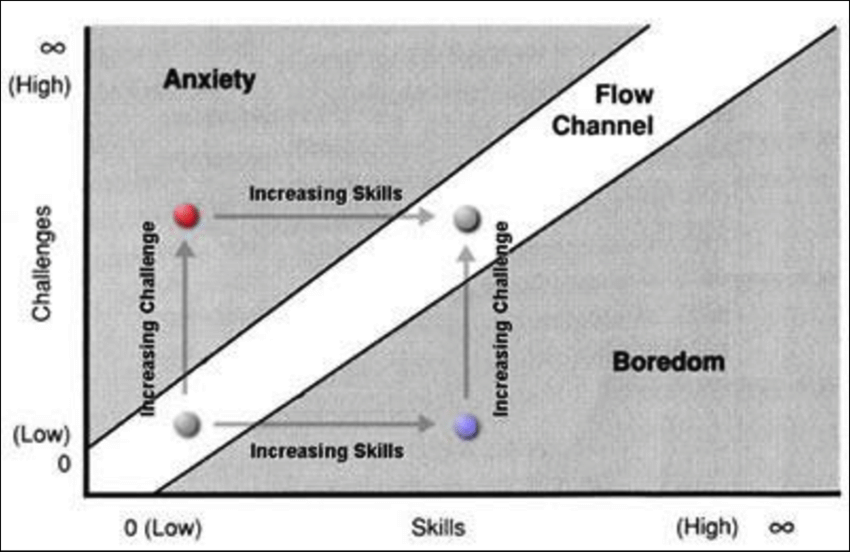
<p>Flow states exist in the fine line between boredom and anxiety.&nbsp;</p>


<p>The challenge we face and the skills required to overcome it have to be at the right level, or we risk falling into boredom (when we are overskilled for the task) or anxiety (when our perceived skill level isn’t good enough).</p>


<p>The chart below shows this.</p>


<figure class="wp-block-image size-full"><img decoding="async" width="850" height="552" src="https://humanefutureofwork.com/wp-content/uploads/2024/01/Anxiety-Boredom-and-Flow-Csikszenmihayi.png" alt="" class="wp-image-4102" srcset="https://humanefutureofwork.com/wp-content/uploads/2024/01/Anxiety-Boredom-and-Flow-Csikszenmihayi.png 850w, https://humanefutureofwork.com/wp-content/uploads/2024/01/Anxiety-Boredom-and-Flow-Csikszenmihayi-300x195.png 300w, https://humanefutureofwork.com/wp-content/uploads/2024/01/Anxiety-Boredom-and-Flow-Csikszenmihayi-768x499.png 768w, https://humanefutureofwork.com/wp-content/uploads/2024/01/Anxiety-Boredom-and-Flow-Csikszenmihayi-585x380.png 585w" sizes="(max-width: 850px) 100vw, 850px" /><figcaption class="wp-element-caption">The Flow chart, aka the Anxiety-Boredom chart</figcaption></figure>


<p>This equilibrium rarely remains stable, which is good. This instability is the reason behind flow states, causing personal growth and increased complexity of tasks and us as persons.&nbsp;</p>


<p>When we undertake a task repeatedly, our skill level improves with practice, so we move to the right in the chart and out of the flow state channel. We are now bored because the task is too easy for us, so we increase the level of the challenge until we are again in the flow state channel.&nbsp;</p>


<p>We could also increase the level of the challenge, even if we aren’t sufficiently skilled yet. This will create anxiety at first, but we will be forced to improve our skill level to bring it into the flow state and avoid being anxious.</p>


<p>This is how we move inside the flow channel to the right and up in the chart. This is how we grow and self-actualise</p>


<p>Flow states are enjoyable, so we should aim to have them because they are enjoyable in and of themselves. They are also an essential engine of personal growth and self-actualisation.</p>


<h2 class="wp-block-heading" id="h-how-to-get-flow">How to get flow</h2>


<p>Csikszentmihalyi tells us about different ways to reach flow states. We can get there by doing a task, by doing something with our bodies and our minds… all our parts have the potential to make us reach a flow state.</p>


<p>With our bodies, we can reach flow states by playing sports or exercising. There are some steps we should follow to ensure we get into a flow state:</p>


<p>&#8211; Set an overall goal and smaller sub-goals, such as running a marathon in under 3:30 hours or a kilometre in under 5 minutes.</p>


<p>&#8211; Find ways to measure progress toward those goals. Continuing with the running example, this would mean running 1, 5 or 10 km faster every week or running ever longer distances at a similar pace.</p>


<p>&#8211; Concentrate on what you are doing, be mindful, and focus on the finer details of your performance. How do you feel when running uphill? And when you run intervals?</p>


<p>&#8211; Develop the skills necessary to interact successfully with the opportunities present in your environment. What is your running technique like? How can you improve it?</p>


<p>&#8211; Keep raising the stakes if the activity becomes boring. Can you run the next marathon below 3 hours?</p>


<p>We can enter flow states with nearly everything: reading, playing games, conducting philosophical thinking, playing an instrument, building Excel sheets, drawing, writing, listening to music, meditating, analysing the stock market… the list is endless.</p>


<p>The process will be similar in all these activities: set goals, concentrate, look for feedback from the task itself, and just get better and better.&nbsp;</p>


<h2 class="wp-block-heading" id="h-the-more-the-better">The more, the better?</h2>


<p>Flow states sound like the best thing since slide bread, but are they? Is it true that the more, the better?&nbsp;</p>


<p>They are positive processes indeed. They are enjoyable, and they help us grow. The more often we enter flow states, the better our quality of life should be.&nbsp;</p>


<p>So the short answer to the question is yes, the more, the better, but with some caveats. Like in all aspects of life, moderation and balance are key. We can have too much of a good thing, and flow states are no exception.</p>


<p>I am unsure if we have physical limits on the number of flow hours we can reach daily, but we cannot be lost indefinitely in flow. Sometimes, we need to come out of it and carry on with the rest of our lives.&nbsp;</p>


<p>Also, could a flow state be addictive? I’m not sure, but I can imagine it being so—perhaps not the flow state itself but the activity that brings us so much joy and growth. We may like running, reading, or meditating so much that it becomes a central focus in our lives.&nbsp;</p>


<p>You may say, “There is nothing wrong with it as long as it is a healthy habit”.&nbsp;</p>


<p>And I’d reply, “Of course not, as long as you make a clear distinction between a habit and an obsession”.&nbsp;</p>


<p>I have been obsessed with running, and it was cool, but there were times when it wasn’t healthy or good for me. It was the only thing I thought about, and it hurt other aspects of my life.</p>


<p>So, by all means, keep bringing on the flow states and keep enjoying them, but please do yourself a favour and do not get hooked on the activities that bring them on.</p>


<p></p>


<h3 class="wp-block-heading" id="h-join-the-newsletter-to-get-more-content-like-this"><a href="https://humanefutureofwork.com/stay-updated/">Join the Newsletter to get more content like this</a></h3>
<p>The post <a href="https://humanefutureofwork.com/flow-states-the-more-the-better/">Flow states – the more, the better?</a> appeared first on <a href="https://humanefutureofwork.com">Humane Future of Work</a>.</p>
]]></content>
		
					<link rel="replies" type="text/html" href="https://humanefutureofwork.com/flow-states-the-more-the-better/?utm_source=rss&#038;utm_medium=rss&#038;utm_campaign=flow-states-the-more-the-better#comments" thr:count="0" />
			<link rel="replies" type="application/atom+xml" href="https://humanefutureofwork.com/flow-states-the-more-the-better/feed/atom/" thr:count="0" />
			<thr:total>0</thr:total>
			</entry>
		<entry>
		<author>
			<name>Iker Urrutia</name>
					</author>

		<title type="html"><![CDATA[Arrival Fallacy: No, Happiness Isn’t Somewhere in the Future]]></title>
		<link rel="alternate" type="text/html" href="https://humanefutureofwork.com/arrival-fallacy-no-happiness-isnt-somewhere-in-the-future/?utm_source=rss&#038;utm_medium=rss&#038;utm_campaign=arrival-fallacy-no-happiness-isnt-somewhere-in-the-future" />

		<id>https://humanefutureofwork.com/?p=4090</id>
		<updated>2023-12-29T09:27:36Z</updated>
		<published>2023-12-29T09:27:32Z</published>
		<category scheme="https://humanefutureofwork.com/" term="Purpose and meaning" /><category scheme="https://humanefutureofwork.com/" term="happiness" />
		<summary type="html"><![CDATA[<p>Arrival fallacy or why we think happiness is always around the corner. It will not come to us after that promotion, marriage, or child is born; if it does, it will only be temporary.</p>
<p>The post <a href="https://humanefutureofwork.com/arrival-fallacy-no-happiness-isnt-somewhere-in-the-future/">Arrival Fallacy: No, Happiness Isn’t Somewhere in the Future</a> appeared first on <a href="https://humanefutureofwork.com">Humane Future of Work</a>.</p>
]]></summary>

					<content type="html" xml:base="https://humanefutureofwork.com/arrival-fallacy-no-happiness-isnt-somewhere-in-the-future/?utm_source=rss&#038;utm_medium=rss&#038;utm_campaign=arrival-fallacy-no-happiness-isnt-somewhere-in-the-future"><![CDATA[
<p>Arrival fallacy / Photo by <a href="https://unsplash.com/@jblesly?utm_content=creditCopyText&amp;utm_medium=referral&amp;utm_source=unsplash">Lesly Juarez</a> on <a href="https://unsplash.com/photos/long-black-haired-woman-smiling-close-up-photography-1AhGNGKuhR0?utm_content=creditCopyText&amp;utm_medium=referral&amp;utm_source=unsplash">Unsplash</a></p>


<h2 class="wp-block-heading" id="h-arrival-fallacy-or-why-we-think-happiness-is-always-around-the-corner-it-will-not-come-to-us-after-that-promotion-marriage-or-child-is-born-if-it-does-it-will-only-be-temporary">Arrival fallacy or why we think happiness is always around the corner. It will not come to us after that promotion, marriage, or child is born; if it does, it will only be temporary.</h2>


<p>When I get that promotion, I’ll finally be happy.&nbsp;</p>


<p>Or when I marry her. When I have a child. Win that deal. Be the number one in school. Win the championship. Move to that new city.</p>


<p>We tend to condition our happiness and fulfilment to some event in the future. We tell ourselves we are not happy yet, but we’ll be when this event finally happens.</p>


<p>We prepare, plan, wait and fight for it, and when it finally happens, we realise that eternal happiness and bliss haven’t arrived yet. It is as elusive as ever.</p>


<p>This is what behavioural scientist&nbsp;<a target="_blank" href="https://en.wikipedia.org/wiki/Tal_Ben-Shahar" rel="noreferrer noopener">Tal Ben Shahar</a>&nbsp;aptly called the arrival fallacy, which is the belief that if we achieve a goal or arrive at a destination sometime in the future, we will be happy and contented.</p>


<p>Happiness is always arriving, but it never seems to arrive. It’s always in the future.</p>


<h2 class="wp-block-heading" id="h-the-hedonic-adaptation-or-why-reaching-goals-won-t-make-you-happy"><strong>The Hedonic adaptation, or why reaching goals won’t make you happy</strong></h2>


<p>Psychologists have demonstrated that people rapidly assimilate their highs and downs. We settle into our baseline happiness level immediately after something that makes us happy or sad. This is what they call Hedonic adaptation.</p>


<p>It is also known as&nbsp;<a target="_blank" href="https://www.psychologytoday.com/us/basics/hedonic-treadmill#:~:text=The%20hedonic%20treadmill%20is%20the,was%20prior%20to%20these%20experiences." rel="noreferrer noopener">the Hedonic treadmill</a>&nbsp;because if you pursue happiness by adding positive experiences, you will work hard for those experiences, like on a treadmill, but your overall happiness won’t increase by much. Your body adapts to what you get, then goes back to normal.</p>


<p>It’s like when you receive a pay rise. The first month, you feel happy about it. The second paycheck may still be nice, but by the third one, you will have gotten used to it and will be thinking about the long time you will need to wait for the subsequent rise.&nbsp;</p>


<p>If you link your happiness to achieving your next goal, be it at work, romantic life or any other area of your life, Hedonic adaptation will make sure that when you reach it, you will quickly get used to it and it won’t add much to your overall happiness.&nbsp;</p>


<p>Nobody said being human was easy.</p>


<figure class="wp-block-image size-large"><img decoding="async" width="683" height="1024" src="https://humanefutureofwork.com/wp-content/uploads/2023/12/mike-cox-06EpjZiMz_E-unsplash-683x1024.jpg" alt="" class="wp-image-4093" srcset="https://humanefutureofwork.com/wp-content/uploads/2023/12/mike-cox-06EpjZiMz_E-unsplash-683x1024.jpg 683w, https://humanefutureofwork.com/wp-content/uploads/2023/12/mike-cox-06EpjZiMz_E-unsplash-200x300.jpg 200w, https://humanefutureofwork.com/wp-content/uploads/2023/12/mike-cox-06EpjZiMz_E-unsplash-768x1152.jpg 768w, https://humanefutureofwork.com/wp-content/uploads/2023/12/mike-cox-06EpjZiMz_E-unsplash-1024x1536.jpg 1024w, https://humanefutureofwork.com/wp-content/uploads/2023/12/mike-cox-06EpjZiMz_E-unsplash-1365x2048.jpg 1365w, https://humanefutureofwork.com/wp-content/uploads/2023/12/mike-cox-06EpjZiMz_E-unsplash-1920x2880.jpg 1920w, https://humanefutureofwork.com/wp-content/uploads/2023/12/mike-cox-06EpjZiMz_E-unsplash-1170x1755.jpg 1170w, https://humanefutureofwork.com/wp-content/uploads/2023/12/mike-cox-06EpjZiMz_E-unsplash-585x878.jpg 585w, https://humanefutureofwork.com/wp-content/uploads/2023/12/mike-cox-06EpjZiMz_E-unsplash-scaled.jpg 1707w" sizes="(max-width: 683px) 100vw, 683px" /><figcaption class="wp-element-caption">Walking on the Hedonic treadmill, and never getting to the final destination / Photo by <a href="https://unsplash.com/@iprefermike?utm_content=creditCopyText&amp;utm_medium=referral&amp;utm_source=unsplash">Mike Cox</a> on <a href="https://unsplash.com/photos/a-woman-running-on-a-treadmill-in-a-gym-06EpjZiMz_E?utm_content=creditCopyText&amp;utm_medium=referral&amp;utm_source=unsplash">Unsplash</a></figcaption></figure>


<h2 class="wp-block-heading" id="h-goals-still-matter"><strong>Goals still matter</strong></h2>


<p>This doesn’t mean we shouldn’t have goals and objectives in life. Goals still matter.</p>


<p>They may not add to your overall happiness when you achieve them, but goals have an essential role in your life. It is difficult to achieve much without goals.</p>


<p>Goals help us aim for what we want to achieve and measure our progress. They set us on the right track and let us know when we have arrived at the destination. The happiness or satisfaction we will feel when we get there may be short-lived, but it is still there.&nbsp;</p>


<p>Having a goal to strive for gives us purpose and direction. Aiming for the goal can actually bring us more happiness than reaching the goal itself, even if we often don’t notice this.&nbsp;</p>


<h2 class="wp-block-heading" id="h-enjoy-the-process-enjoy-the-journey"><strong>Enjoy the process, enjoy the journey</strong></h2>


<p>You will live a happier life if you stop fixing your happiness in some future event and enjoy the process of getting there.&nbsp;</p>


<p>Enjoy the journey, not the destination.</p>


<p>As James Clear&nbsp;<a target="_blank" href="https://humanefutureofwork.com/good-habits-make-you-better/" rel="noreferrer noopener">said in his best-selling book Atomic Habits</a>, “You do not raise to the level of your goals. You fall to the level of your systems.”&nbsp;</p>


<p>You may have very lofty goals, but if you don’t have the right systems in place, you will never reach them.</p>


<p>The process, system or journey, call it as you wish, but that’s what really matters. I will go a step further and say that not only should you focus more on the process than on your objectives, you should also try to enjoy it more.</p>


<p>The moment you stop obsessing with your goals and start enjoying the journey to get there, a happier state of being will come to you.&nbsp;</p>


<p>For that, practising mindfulness or meditation helps. As many meditation gurus know, your life isn’t happening in the past or the future, but only in your present, so stop regretting the past and being anxious about the future, and start enjoying the present more.&nbsp;</p>


<p>This includes enjoying the little quirks of the journey or the process that will get you to your goals.</p>


<p>Another thing you can do to enjoy more the process is to practice gratitude. Be more grateful for the wonderful things life puts in front of you. I’m sure plenty of them already exist, but you just ignore them.</p>


<p>Stop obsessing over that big promotion or buying that big house, and be more grateful for life’s little pleasures.&nbsp;</p>


<h2 class="wp-block-heading" id="h-the-secret-to-happiness-is"><strong>The secret to happiness is…</strong></h2>


<p>There is no secret recipe to happiness. Happiness is not and will never be a permanent state. Sometimes, we will feel happier than others, but sadness, pain and suffering are also part of life and will always be.&nbsp;</p>


<p>Still, it helps to get some things clear. Happiness is like love; the more you seek it, the more elusive it is. Happiness usually only happens when you stop actively looking for it.</p>


<p>Happiness doesn’t reside in achieving goals and objectives. It won’t come sometime in the future.&nbsp;</p>


<p>People with a positive mindset are likelier to be happy. Also, people with meaningful relationships who spend time with people they love and like will live happier lives. Lastly, one of the secrets of happiness resides in wanting and needing less, not more.&nbsp;</p>


<p>As Seneca said, “It is not the man who has too little who is poor, but the one who hankers after more.”</p>


<p>There is no secret recipe to happiness, but if there were one, it would at least have these three ingredients: a positive outlook, meaningful relationships, and wanting little.</p>


<h2 class="wp-block-heading" id="h-life-is-more-like-music-than-a-journey"><strong>Life is more like music than a journey</strong></h2>


<p>I recently heard&nbsp;<a target="_blank" href="https://dynamic.wakingup.com/clip/CLE2134-CA4AD4?utm_source=braze&amp;utm_campaign=2023_w52_EOYreview" rel="noreferrer noopener">an audio clip</a>&nbsp;from&nbsp;<a target="_blank" href="https://en.wikipedia.org/wiki/Alan_Watts" rel="noreferrer noopener">Alan Watts</a>&nbsp;that was linked to the arrival fallacy and everything discussed in this post.</p>


<p>He said we often thought life was like a journey but that it was more like music. Westerners are used to reducing the time between A and B when travelling, so the trip is no longer about enjoying the journey but about reaching our destination, the sooner, the better.</p>


<p>If we take life as such a journey, we are entirely missing the point. For Watts, life is more like music. It is playful, and its whole point is to enjoy it from beginning to end. When listening to music, we are not waiting for it to be finished (unless the song is terrible); we want to enjoy it while it lasts, all of it.&nbsp;</p>


<p>Watts reminds us that in our Western education system, we go from 1st to 2nd grade, from primary to secondary school, then to university, then to the job market, and then we go after the next promotion. Our achievements are always somewhere in the future, and before we realise we reach our retirement age, we are sick and tired, and life has passed before us without us noticing and enjoying it.</p>


<p>The arrival fallacy is thrust upon us through our education and work systems.</p>


<p>Stop.</p>


<p>It doesn’t have to be this way.&nbsp;</p>


<p>Stop waiting for the next big thing to happen, and enjoy the moment you are in. After all, life is only lived and enjoyed in the present.</p>


<h3 class="wp-block-heading" id="h-join-the-newsletter-to-get-more-content-like-this"><a href="https://humanefutureofwork.com/stay-updated/">Join the Newsletter to get more content like this</a></h3>
<p>The post <a href="https://humanefutureofwork.com/arrival-fallacy-no-happiness-isnt-somewhere-in-the-future/">Arrival Fallacy: No, Happiness Isn’t Somewhere in the Future</a> appeared first on <a href="https://humanefutureofwork.com">Humane Future of Work</a>.</p>
]]></content>
		
					<link rel="replies" type="text/html" href="https://humanefutureofwork.com/arrival-fallacy-no-happiness-isnt-somewhere-in-the-future/?utm_source=rss&#038;utm_medium=rss&#038;utm_campaign=arrival-fallacy-no-happiness-isnt-somewhere-in-the-future#comments" thr:count="0" />
			<link rel="replies" type="application/atom+xml" href="https://humanefutureofwork.com/arrival-fallacy-no-happiness-isnt-somewhere-in-the-future/feed/atom/" thr:count="0" />
			<thr:total>0</thr:total>
			</entry>
		<entry>
		<author>
			<name>Iker Urrutia</name>
					</author>

		<title type="html"><![CDATA[Authenticity or living the life you are meant to live]]></title>
		<link rel="alternate" type="text/html" href="https://humanefutureofwork.com/authenticity-or-living-the-life-you-are-meant-to-live/?utm_source=rss&#038;utm_medium=rss&#038;utm_campaign=authenticity-or-living-the-life-you-are-meant-to-live" />

		<id>https://humanefutureofwork.com/?p=4082</id>
		<updated>2023-12-13T06:59:57Z</updated>
		<published>2023-12-13T06:57:19Z</published>
		<category scheme="https://humanefutureofwork.com/" term="Personal Growth" /><category scheme="https://humanefutureofwork.com/" term="Purpose and meaning" /><category scheme="https://humanefutureofwork.com/" term="authenticity" />
		<summary type="html"><![CDATA[<p>Authenticity is one of my values, but what does it mean to be authentic and live an authentic life?</p>
<p>The post <a href="https://humanefutureofwork.com/authenticity-or-living-the-life-you-are-meant-to-live/">Authenticity or living the life you are meant to live</a> appeared first on <a href="https://humanefutureofwork.com">Humane Future of Work</a>.</p>
]]></summary>

					<content type="html" xml:base="https://humanefutureofwork.com/authenticity-or-living-the-life-you-are-meant-to-live/?utm_source=rss&#038;utm_medium=rss&#038;utm_campaign=authenticity-or-living-the-life-you-are-meant-to-live"><![CDATA[
<p>Photo by <a href="https://unsplash.com/@sofiaguaico?utm_content=creditCopyText&amp;utm_medium=referral&amp;utm_source=unsplash">Sofia Guaico</a> on <a href="https://unsplash.com/photos/person-in-blue-denim-jeans-and-white-sneakers-xkMIB7DMwbE?utm_content=creditCopyText&amp;utm_medium=referral&amp;utm_source=unsplash">Unsplash</a></p>


<h2 class="wp-block-heading" id="h-authenticity-is-one-of-my-values-but-what-it-means-to-be-authentic-and-live-an-authentic-life">Authenticity is one of my values, but what it means to be authentic and live an authentic life? </h2>


<p>Authenticity is one of my personal&nbsp;<a target="_blank" href="https://humanefutureofwork.com/there-are-no-good-or-bad-values/" rel="noreferrer noopener">values</a>.&nbsp;</p>


<p>I don&#8217;t want to pretend to be someone I am not. I want to live by my values and be who I am. I don&#8217;t want to be surrounded by inauthentic people, either.</p>


<p>But what does it mean to be authentic?</p>


<p>Philosophers and psychologists have been arguing about what authenticity for a long time. Let&#8217;s look at it in more detail.</p>


<h2 class="wp-block-heading" id="h-what-does-it-mean-to-be-authentic">What does it mean to be authentic?</h2>


<h3 class="wp-block-heading" id="h-existentialist-views">Existentialist views</h3>


<p>First, we will turn to existentialism for some of our answers.&nbsp;</p>


<p><em>Related to this, please read&nbsp;</em><a target="_blank" href="https://humanefutureofwork.com/existential-coaching-what-is-it/" rel="noreferrer noopener"><em>Existential Coaching: what is it?</em></a></p>


<p>Existential thinkers like Kierkegaard and Sartre wrote extensively about authenticity and what it meant to be authentic. For them, authenticity meant living the life we were meant to live, living it according to our values and purpose, not the values of someone else.&nbsp;</p>


<p>Existentialists believe we build our essence and who we are through our actions and decisions. We are free to live the life we want, but this should be lived according to our values and purpose, or it risks not being authentic. We should live our lives according to our values and norms, not those imposed on us by society or others.</p>


<p>Sartre introduced the concept of living in &#8220;bad faith&#8221; to signify people who were not living according to their values. Living in bad faith means not being authentic.&nbsp;</p>


<p>For existentialists, this is one of the biggest sins a human being can do.</p>


<p>If we follow their argument logically, we should first&nbsp;<a target="_blank" href="https://humanefutureofwork.com/know-thyself-or-the-importance-of-self-awareness/" rel="noreferrer noopener">know ourselves</a>&nbsp;(or all our different selves,&nbsp;<a target="_blank" href="https://humanefutureofwork.com/multiplicity-of-personality-theory-how-many-selves-do-you-have/" rel="noreferrer noopener">according to multiplicity theory</a>), who we are, and our values and&nbsp;<a target="_blank" href="https://humanefutureofwork.com/i-dont-know-where-we-are-going-but-i-know-exactly-how-to-get-there/" rel="noreferrer noopener">purpose</a>&nbsp;well in order to be really authentic. You cannot be guided by your values if you don&#8217;t know what they are.&nbsp;</p>


<h3 class="wp-block-heading" id="h-enter-maslow">Enter Maslow</h3>


<p>Maslow also wrote about authenticity in his book&nbsp;<a target="_blank" href="https://www.amazon.com/Farther-Reaches-Human-Nature/dp/0140194703" rel="noreferrer noopener">The Farther Reaches of Human Nature</a>. As was to be expected, he linked it to&nbsp;<a target="_blank" href="https://humanefutureofwork.com/is-self-actualisation-the-secret-to-a-happy-life/" rel="noreferrer noopener">self-actualisation</a>&nbsp;in the sense that more self-actualised people tend to be more authentic, as they understand themselves better and don&#8217;t need affirmation or commands from others.</p>


<p>For Maslow, authentic people are capable of listening to their inner voices about who they really are and what their natural desires and characteristics are, not the ones imposed by others. Authentic people know what they want and know equally clearly what they don&#8217;t want.&nbsp;</p>


<p>Inauthentic people are just the opposite:</p>


<blockquote class="wp-block-quote is-layout-flow wp-block-quote-is-layout-flow">
<p>&#8220;Other people, in contrast, seem to be empty, out of touch with their own inner signals. They eat, defecate, and go to sleep by the clock&#8217;s cues, rather than by the cues of their own bodies. They use external criteria for everything from choosing their food (&#8220;it&#8217;s good for you&#8221;) and clothing (&#8220;it&#8217;s in style&#8221;) to questions about values and ethics (&#8220;my daddy told me to&#8221;).</p>
<cite>Abraham Maslow, in <em>The Farther Reaches of Human Nature</em></cite></blockquote>


<p>And you, are you guiding your ethical decisions on what your daddy told you?&nbsp;</p>


<h2 class="wp-block-heading" id="h-authentic-leadership">Authentic Leadership</h2>


<p>In the 50s and 60s, leaders had to be tough, charismatic, and commanding, but in the 70s and 80s, this started to change, and softer skills and traits started to be valued. There suddenly was a preference for a more humane and humanistic leader who would understand the needs of their team members to motivate them.&nbsp;</p>


<p>This gave then place to&nbsp;<a target="_blank" href="https://www.umassglobal.edu/news-and-events/blog/what-is-transformational-leadership#:~:text=A%20transformational%20leadership%20style%20inspires,leaders%20reach%20their%20full%20potential." rel="noreferrer noopener">transformational leadership</a>,&nbsp;<a target="_blank" href="https://www.shrm.org/executive/resources/articles/pages/servant-leadership-.aspx#:~:text=Servant%20leadership%20is%20a%20leadership,thrive%20as%20their%20authentic%20self." rel="noreferrer noopener">servant leadership</a>&nbsp;and&nbsp;<a target="_blank" href="https://www.routledge.com/The-Wise-Leader-A-Practical-Guide-for-Thinking-Differently-About-Leadership/Lawrence-Skinner/p/book/9781032257495" rel="noreferrer noopener">wise leadership</a>, which are all interesting concepts with valuable aspects (personally,&nbsp;<a target="_blank" href="https://humanefutureofwork.com/the-wise-leader/" rel="noreferrer noopener">I have a soft spot for wise leadership</a>). The growing interest in authentic leadership should be understood in this context.</p>


<p>The thinking goes like this: people like people who are authentic, not fake, and we human beings can notice when someone is not being authentic, even if this noticing is often done unconsciously, so people who are authentic and show themselves as they really are, will engage and motivate better their team members.</p>


<p>It is a sound logic. As I already mentioned, authenticity is one of my personal values, so I cannot but agree with this approach.&nbsp;</p>


<p>But it is not as easy as it sounds. What does it mean to be an authentic leader? And can a leader always be authentic? In all situations?</p>


<p>If we understand authenticity in the existential sense, as a leader acting in alignment with their values, then that is possible, even if sometimes those values could contradict each other depending on the situation (nobody said it was easy to be authentic!). On the other hand, if we understand authenticity as always being natural, honest, and frank and showing oneself transparently as they are in every situation, this could create some difficulties in some situations.</p>


<p>After all, a leader&#8217;s best choice in certain situations is to hide some part of the truth or tell a white lie to their team members, clients or partners.&nbsp;</p>


<p>Would a leader doing this be truly authentic? In the existential sense, certainly; in the other one, I&#8217;m not so sure.</p>


<h2 class="wp-block-heading" id="h-authenticity-in-a-world-of-deepfakes-and-beauty-filters">Authenticity in a world of deepfakes and beauty filters</h2>


<p>If you look at the state of the world today, you would be forgiven for thinking we are living in probably the most inauthentic times in history.&nbsp;</p>


<p>And perhaps you would be right.</p>


<p>After all, we are living in a world where people can&nbsp;<a target="_blank" href="https://www.technologyreview.com/2021/09/13/1035449/ai-deepfake-app-face-swaps-women-into-porn/" rel="noreferrer noopener">turn other people into porn stars</a>&nbsp;by just tapping into an app. Technology allows&nbsp;<a target="_blank" href="https://www.creativebloq.com/features/deepfake-examples" rel="noreferrer noopener">deepfakes that look increasingly verisimilar</a>; it is almost impossible to detect some of them.&nbsp;</p>


<p>We also live in a world where millions show how they live to their followers, but they aren&#8217;t showing all of it, only their most glamorous bites. People use filters to improve their pictures or carefully set up the elements of a picture to make it seem better than it really is. Everybody seems to be living a grand life, eating in Michelin-starred restaurants and visiting white-sanded tropical beaches, but then again, we all know their mundane everyday life isn&#8217;t always like this.</p>


<figure class="wp-block-image size-large"><img loading="lazy" decoding="async" width="870" height="1024" src="https://humanefutureofwork.com/wp-content/uploads/2023/12/laura-chouette-IivFrTVUpEw-unsplash-870x1024.jpg" alt="" class="wp-image-4085" srcset="https://humanefutureofwork.com/wp-content/uploads/2023/12/laura-chouette-IivFrTVUpEw-unsplash-870x1024.jpg 870w, https://humanefutureofwork.com/wp-content/uploads/2023/12/laura-chouette-IivFrTVUpEw-unsplash-255x300.jpg 255w, https://humanefutureofwork.com/wp-content/uploads/2023/12/laura-chouette-IivFrTVUpEw-unsplash-768x904.jpg 768w, https://humanefutureofwork.com/wp-content/uploads/2023/12/laura-chouette-IivFrTVUpEw-unsplash-1305x1536.jpg 1305w, https://humanefutureofwork.com/wp-content/uploads/2023/12/laura-chouette-IivFrTVUpEw-unsplash-1740x2048.jpg 1740w, https://humanefutureofwork.com/wp-content/uploads/2023/12/laura-chouette-IivFrTVUpEw-unsplash-1920x2260.jpg 1920w, https://humanefutureofwork.com/wp-content/uploads/2023/12/laura-chouette-IivFrTVUpEw-unsplash-1170x1377.jpg 1170w, https://humanefutureofwork.com/wp-content/uploads/2023/12/laura-chouette-IivFrTVUpEw-unsplash-585x689.jpg 585w" sizes="(max-width: 870px) 100vw, 870px" /><figcaption class="wp-element-caption">Don&#8217;t forget the filters / Photo by <a href="https://unsplash.com/@laurachouette?utm_content=creditCopyText&amp;utm_medium=referral&amp;utm_source=unsplash">Laura Chouette</a> on <a href="https://unsplash.com/photos/woman-in-white-tank-top-and-blue-denim-jeans-sitting-on-yellow-sofa-IivFrTVUpEw?utm_content=creditCopyText&amp;utm_medium=referral&amp;utm_source=unsplash">Unsplash</a></figcaption></figure>


<p>We seem to be living in a world of pretending to be someone we are not or where other people can make us look like someone we are not.&nbsp;</p>


<p>It does look like we might be living in the more inauthentic times in history.</p>


<p>And still, I believe we have the potential to be more authentic than ever. There are more and more tools and help out there to help each of us navigate this challenging world, understand who we are, and live the life we are meant to live and want to live.&nbsp;</p>


<h2 class="wp-block-heading" id="h-know-thyself-and-live-an-authentic-life">Know thyself, and live an authentic life</h2>


<p>This is what it means to live an authentic life. Many people seem to be lost in a materialistic and ultimately nihilistic way of life made up of illusions and pretending, but many others are awakening and realising this is not the life they want to live.</p>


<p>Meditate, start&nbsp;<a target="_blank" href="https://humanefutureofwork.com/a-simple-guide-to-coaching/" rel="noreferrer noopener">a coaching process</a>, see a psychologist, ask for feedback from your friends or colleagues, do exercises to understand your purpose in life, identify your values… In a nutshell, know and understand yourself better, and once you do, stick to being who you really are.</p>


<p>That&#8217;s what it means to be authentic, nothing more, nothing less. Life is nothing but a journey to discover who you are and live the life you are meant to live authentically. Nothing more, nothing less.</p>


<h3 class="wp-block-heading" id="h-join-the-newsletter-to-get-more-content-like-this"><a href="https://humanefutureofwork.com/stay-updated/">Join the Newsletter to get more content like this</a></h3>
<p>The post <a href="https://humanefutureofwork.com/authenticity-or-living-the-life-you-are-meant-to-live/">Authenticity or living the life you are meant to live</a> appeared first on <a href="https://humanefutureofwork.com">Humane Future of Work</a>.</p>
]]></content>
		
					<link rel="replies" type="text/html" href="https://humanefutureofwork.com/authenticity-or-living-the-life-you-are-meant-to-live/?utm_source=rss&#038;utm_medium=rss&#038;utm_campaign=authenticity-or-living-the-life-you-are-meant-to-live#comments" thr:count="0" />
			<link rel="replies" type="application/atom+xml" href="https://humanefutureofwork.com/authenticity-or-living-the-life-you-are-meant-to-live/feed/atom/" thr:count="0" />
			<thr:total>0</thr:total>
			</entry>
		<entry>
		<author>
			<name>Iker Urrutia</name>
					</author>

		<title type="html"><![CDATA[Multiplicity of Personality theory: How Many Selves Do You Have?]]></title>
		<link rel="alternate" type="text/html" href="https://humanefutureofwork.com/multiplicity-of-personality-theory-how-many-selves-do-you-have/?utm_source=rss&#038;utm_medium=rss&#038;utm_campaign=multiplicity-of-personality-theory-how-many-selves-do-you-have" />

		<id>https://humanefutureofwork.com/?p=3987</id>
		<updated>2023-12-04T10:31:45Z</updated>
		<published>2023-11-29T08:01:49Z</published>
		<category scheme="https://humanefutureofwork.com/" term="Personal Growth" /><category scheme="https://humanefutureofwork.com/" term="mind" /><category scheme="https://humanefutureofwork.com/" term="psychology" />
		<summary type="html"><![CDATA[<p>Multiplicity theory says that we all have different selves or personalities showing up in different situations. This is an asset.</p>
<p>The post <a href="https://humanefutureofwork.com/multiplicity-of-personality-theory-how-many-selves-do-you-have/">Multiplicity of Personality theory: How Many Selves Do You Have?</a> appeared first on <a href="https://humanefutureofwork.com">Humane Future of Work</a>.</p>
]]></summary>

					<content type="html" xml:base="https://humanefutureofwork.com/multiplicity-of-personality-theory-how-many-selves-do-you-have/?utm_source=rss&#038;utm_medium=rss&#038;utm_campaign=multiplicity-of-personality-theory-how-many-selves-do-you-have"><![CDATA[
<p>Photo by <a href="https://unsplash.com/@ohamko?utm_content=creditCopyText&amp;utm_medium=referral&amp;utm_source=unsplash">Matúš Kovačovský</a> on <a href="https://unsplash.com/photos/sephia-photography-of-person-eIvLuyDjCQI?utm_content=creditCopyText&amp;utm_medium=referral&amp;utm_source=unsplash">Unsplash</a></p>


<h2 class="wp-block-heading" id="h-multiplicity-theory-says-that-we-all-have-different-selves-or-personalities-showing-up-in-different-situations-if-used-correctly-this-is-an-asset">Multiplicity theory says that we all have different selves or personalities showing up in different situations. If used correctly, this is an asset.</h2>


<p>I recently read about the multiplicity of personality theory in the book&nbsp;<a target="_blank" href="https://www.routledge.com/The-Wise-Leader-A-Practical-Guide-for-Thinking-Differently-About-Leadership/Lawrence-Skinner/p/book/9781032257495" rel="noreferrer noopener">The Wise Leader</a>. I found the concept interesting and its implications for personal development fascinating.</p>


<p>The multiplicity of personality theory postulates that we don&#8217;t have one single personality or self but many. There is not one single Iker within me, but many different ones, talking to each other and working together to achieve my goals and satisfy my needs. I will be more or less effective depending on how well they work together and whether the adequate self arises for each situation.&nbsp;</p>


<p>This doesn&#8217;t mean we all have some sort of personality disorder. What is known as multiple personality disorder happens when the mind gets highly fragmented and polarised and becomes non-functional. Most of us have modular brains with different parts and selves but are reasonably functional.</p>


<h2 class="wp-block-heading" id="h-what-is-the-multiplicity-of-personality-theory">What is the multiplicity of personality theory?</h2>


<p>Paul Lawrence and Suzy Skinner in The Wise Leader argue that one of the main facets of a wise leader is knowing him or herself, and the first step for that is to realise that they don&#8217;t have one single self, but many.</p>


<p>So for them, a wise leader should know their selves, all of them. They no longer talk about self-knowledge and <a href="https://humanefutureofwork.com/know-thyself-or-the-importance-of-self-awareness/">self-awareness</a>, but selves-knowledge and selves-awareness.</p>


<p>As they write, &#8220;there is little evidence to support the notion of a single authentic self&#8221;, and there is plenty of evidence that suggests that, indeed, we have many selves co-existing within us.</p>


<p>There are many different multiplicity theories in psychology, all with the same foundation but with a slightly different twist. For example,&nbsp;<a href="https://www.taylorfrancis.com/books/mono/10.4324/9780203734162/subpersonalities-john-rowan" target="_blank" rel="noreferrer noopener">John Rowan argues</a>&nbsp;that we all have different &#8220;subpersonalities&#8221; specific to each of us, and they can evolve throughout our lives.&nbsp;</p>


<figure class="wp-block-gallery has-nested-images columns-default is-cropped wp-block-gallery-1 is-layout-flex wp-block-gallery-is-layout-flex">
<figure class="wp-block-image size-large"><img loading="lazy" decoding="async" width="1024" height="768" data-id="3990" src="https://humanefutureofwork.com/wp-content/uploads/2023/11/caroline-veronez-bbjmFMdWYfw-unsplash-copia-1024x768.jpg" alt="" class="wp-image-3990" srcset="https://humanefutureofwork.com/wp-content/uploads/2023/11/caroline-veronez-bbjmFMdWYfw-unsplash-copia-1024x768.jpg 1024w, https://humanefutureofwork.com/wp-content/uploads/2023/11/caroline-veronez-bbjmFMdWYfw-unsplash-copia-300x225.jpg 300w, https://humanefutureofwork.com/wp-content/uploads/2023/11/caroline-veronez-bbjmFMdWYfw-unsplash-copia-768x576.jpg 768w, https://humanefutureofwork.com/wp-content/uploads/2023/11/caroline-veronez-bbjmFMdWYfw-unsplash-copia-1536x1152.jpg 1536w, https://humanefutureofwork.com/wp-content/uploads/2023/11/caroline-veronez-bbjmFMdWYfw-unsplash-copia-2048x1536.jpg 2048w, https://humanefutureofwork.com/wp-content/uploads/2023/11/caroline-veronez-bbjmFMdWYfw-unsplash-copia-1920x1440.jpg 1920w, https://humanefutureofwork.com/wp-content/uploads/2023/11/caroline-veronez-bbjmFMdWYfw-unsplash-copia-1170x878.jpg 1170w, https://humanefutureofwork.com/wp-content/uploads/2023/11/caroline-veronez-bbjmFMdWYfw-unsplash-copia-585x439.jpg 585w" sizes="(max-width: 1024px) 100vw, 1024px" /><figcaption class="wp-element-caption">Know your selves / Photo by <a href="https://unsplash.com/@carolineveronez?utm_content=creditCopyText&amp;utm_medium=referral&amp;utm_source=unsplash">Caroline Veronez</a> on <a href="https://unsplash.com/photos/woman-in-blue-and-white-floral-shirt-holding-her-face-bbjmFMdWYfw?utm_content=creditCopyText&amp;utm_medium=referral&amp;utm_source=unsplash">Unsplash</a></figcaption></figure>
</figure>


<p><a target="_blank" href="https://www.foundationifs.org/images/Schwartz_1987_Our_Multiple_Selves.pdf" rel="noreferrer noopener">Richard Schwartz writes about a core self</a>&nbsp;that is accompanied by different parts of the self. These parts can work well together or against each other but are generally well-intended.</p>


<p><a target="_blank" href="https://www.amazon.com/Multiplicity-Science-Personality-Identity-Self/dp/031611538X" rel="noreferrer noopener">Rita Carter believes that</a>&nbsp;different personalities are constantly forming, evolving and fading away. Usually, we would have one or two major personalities, several minors and many micros, which can combine to form minors.&nbsp;</p>


<p>Unlike all the previous psychologists,&nbsp;<a target="_blank" href="https://journals.sagepub.com/doi/pdf/10.2466/02.09.28.CP.1.5" rel="noreferrer noopener">David Lester doesn&#8217;t believe in a single overarching executive self</a>. One of the different selves can be in control at any moment, but when that happens, all the other selves are momentarily suspended.&nbsp;</p>


<p>These are some of the main takes on multiplicity, but there are many more out there.</p>


<h2 class="wp-block-heading" id="h-how-does-multiplicity-theory-affect-you-nbsp">How does multiplicity theory affect you?&nbsp;</h2>


<p>Multiplicity personality theory being correct means that you, like the rest of us, have many different parts, selves, personalities or sub-selves (the language used in the psychology literature to name it is varied).&nbsp;</p>


<p>A successful dialogue between those parts and their getting along will be critical for you to achieve your goals and be happy. If you are like most people, you have never thought about having different selves, and you aren&#8217;t aware of them. You are just you, right? (what makes you, you, is another question we tried to answer&nbsp;<a target="_blank" href="https://humanefutureofwork.com/i-could-be-anybody-so-i-love-everybody/" rel="noreferrer noopener">elsewhere</a>).</p>


<p>Call them like you want, but we all have different parts. Sometimes, I am fearful and timid; others, I am a self-confident extrovert who jokes and tells stories. Both are me, but they are different parts of me. Depending on the situation, a different &#8220;me&#8221; takes over, but they are all &#8220;me&#8221;.&nbsp;</p>


<p>Other people will be very different at home or work. Depending on who they interact with or the specific contexts, they will have different personas.</p>


<p>This may sound daunting or weird, but it&#8217;s actually great if you think about it. It&#8217;s an asset. It means you can leverage your different selves or parts to fit the situations and challenges you face.&nbsp;</p>


<h2 class="wp-block-heading" id="h-nbsp-how-to-make-the-most-of-multiplicity-personality-theory">&nbsp;How to make the most of multiplicity personality theory</h2>


<h3 class="wp-block-heading" id="h-step-1-identification-and-naming">Step 1 – Identification and naming</h3>


<p>The first step is to reflect on your different personalities or selves, identify them, and, why not, give them a name. This will make their identification easier. It can be a name like Mary or Mike, or an adjective like Strong, Joker, or Quiet. Try to identify the different ways you interact with other people and feel and label them.</p>


<h3 class="wp-block-heading" id="h-step-2-awareness">Step 2 – Awareness</h3>


<p>The next step is to be more aware of the situations in which your different selves arise. When is the Joker coming out? And Quiet? What are the telltales or signs of each of your selves?</p>


<p>Be more aware of what&#8217;s happening inside you and which of your selves is taking precedence in each situation or context.</p>


<h3 class="wp-block-heading" id="h-step-3-assess-suitability">Step 3 – Assess suitability</h3>


<p>This step is critical. You need to assess the suitability and appropriateness of your selves in each situation. Are you using Joker when you shouldn&#8217;t? Would a specific situation benefit from you using self X, but you are using Y instead?</p>


<p>You have different parts or subpersonalities, so use them wisely. One of them is the most suitable for each situation, but you may not use them correctly.&nbsp;</p>


<h3 class="wp-block-heading" id="h-step-4-actions">Step 4 &#8211; Actions</h3>


<p>The last step is to take the necessary actions. If you realise that you are not using the appropriate self in certain situations, start being more aware and try to surface the adequate personality for each situation. It might be challenging initially, but with some training, it gets easier.</p>


<h2 class="wp-block-heading" id="h-one-self-for-every-situation">One self for every situation</h2>


<p>If there is one important conclusion to be taken home from this post, it is that we all have different selves, and we should try to use the most suitable self for each situation.</p>


<p>The multiplicity of personalities or selves is an asset and an advantage, not a disorder. Being able to pull different personalities or personal characteristics to face different situations is a valuable resource, but we need to know how to use it correctly.</p>


<p>A coach can help you understand better your multiple selves and make the most of them. They can help you identify your subpersonalities and bring the right one to the fore.</p>


<p>Alternatively, this is something you can work on alone, too, by following the four steps above and practising. It is all about being more aware of all our selves and when they become protagonists. Mindfulness and meditation can help you develop that awareness better and make it easier to label and identify your different selves when they arise.&nbsp;</p>


<p>Which of your selves is reading this article right now? Make sure it shares what they learned with all the other selves that make you, you 😉</p>


<h3 class="wp-block-heading" id="h-join-the-newsletter-to-get-more-content-like-this"><a href="https://humanefutureofwork.com/stay-updated/">Join the Newsletter to get more content like this</a></h3>
<p>The post <a href="https://humanefutureofwork.com/multiplicity-of-personality-theory-how-many-selves-do-you-have/">Multiplicity of Personality theory: How Many Selves Do You Have?</a> appeared first on <a href="https://humanefutureofwork.com">Humane Future of Work</a>.</p>
]]></content>
		
					<link rel="replies" type="text/html" href="https://humanefutureofwork.com/multiplicity-of-personality-theory-how-many-selves-do-you-have/?utm_source=rss&#038;utm_medium=rss&#038;utm_campaign=multiplicity-of-personality-theory-how-many-selves-do-you-have#comments" thr:count="1" />
			<link rel="replies" type="application/atom+xml" href="https://humanefutureofwork.com/multiplicity-of-personality-theory-how-many-selves-do-you-have/feed/atom/" thr:count="1" />
			<thr:total>1</thr:total>
			</entry>
		<entry>
		<author>
			<name>Iker Urrutia</name>
					</author>

		<title type="html"><![CDATA[I could be anybody, so I love everybody]]></title>
		<link rel="alternate" type="text/html" href="https://humanefutureofwork.com/i-could-be-anybody-so-i-love-everybody/?utm_source=rss&#038;utm_medium=rss&#038;utm_campaign=i-could-be-anybody-so-i-love-everybody" />

		<id>https://humanefutureofwork.com/?p=3978</id>
		<updated>2023-12-04T10:32:22Z</updated>
		<published>2023-11-15T07:02:55Z</published>
		<category scheme="https://humanefutureofwork.com/" term="Purpose and meaning" />
		<summary type="html"><![CDATA[<p>I could be anybody, so I try to love everybody. Maybe love is too strong a word, but I do have a positive regard for all.</p>
<p>The post <a href="https://humanefutureofwork.com/i-could-be-anybody-so-i-love-everybody/">I could be anybody, so I love everybody</a> appeared first on <a href="https://humanefutureofwork.com">Humane Future of Work</a>.</p>
]]></summary>

					<content type="html" xml:base="https://humanefutureofwork.com/i-could-be-anybody-so-i-love-everybody/?utm_source=rss&#038;utm_medium=rss&#038;utm_campaign=i-could-be-anybody-so-i-love-everybody"><![CDATA[
<p>Photo by <a href="https://unsplash.com/@evertonvila?utm_content=creditCopyText&amp;utm_medium=referral&amp;utm_source=unsplash">Everton Vila</a> on <a href="https://unsplash.com/photos/woman-on-bike-reaching-for-mans-hand-behind-her-also-on-bike-AsahNlC0VhQ?utm_content=creditCopyText&amp;utm_medium=referral&amp;utm_source=unsplash">Unsplash</a></p>


<h2 class="wp-block-heading" id="h-i-lied-i-don-t-really-love-everybody-i-can-t-but-at-least-i-can-try-to-have-a-positive-regard-for-all-let-me-explain">I lied. I don’t really love everybody, I can’t, but at least I can try to have a positive regard for all. Let me explain.</h2>


<p>I try to meditate every day, at least ten minutes in the mornings, a bit longer at the weekends. I do it with the help of an app called&nbsp;<a target="_blank" href="https://www.wakingup.com/" rel="noreferrer noopener">Waking Up</a>.&nbsp;</p>


<p>Last Saturday, I was halfway through a 30-minute meditation, feeling good, connected with my immediate experiences and trying not to think about anything. Suddenly, I realised somebody was chatting outside my flat, at the doorstep. I could hear them talking, and I started to feel frustrated and annoyed.&nbsp;</p>


<p>A feeling of rage was starting to come up within me because these two women were chatting on my doorstep. Couldn’t they go somewhere else? I was trying to meditate!</p>


<p>Then I realised what I was feeling, and I stopped it there. I was trying to do <a href="https://www.healthline.com/health/metta-meditation#what-to-know" target="_blank" rel="noreferrer noopener">Metta meditation</a>, which focuses on feeling loving-kindness for others and oneself, and I was doing the opposite. </p>


<p>Instead of love, I was feeling rage.&nbsp;</p>


<p>I also realised that those women must be cleaning the staircase in our apartment building. They were chatting while they were cleaning my doorstep and stairs. They were cleaning that for me and my neighbours and having a conversation while they were at it, and I was feeling rage, frustration and annoyance. What kind of ungrateful idiot was I?</p>


<p>I could have been in their place, I could have been them. I then realised they deserved my love instead of my rage.&nbsp;</p>


<h2 class="wp-block-heading" id="h-what-makes-you-you">What makes you, you?</h2>


<p>What makes you, you, and not somebody else? Is it your values, your memories, your body, your beliefs?</p>


<p>None of the above. I think it is just your subjective experience. Only that makes you, you.</p>


<p>We all have had this little thought experiment at some moment in our lives. What would happen if I went to sleep and woke up the next day as my friend, neighbour, colleague, or love crush? You wake up, and suddenly, your hands look different, you have women’s breasts instead of a flat chest (or the other way around), and you are in someone else’s bedroom.&nbsp;</p>


<p>But you know you are still you. Because you are having that subjective experience. You are the one seeing, hearing, touching, and thinking about it. </p>


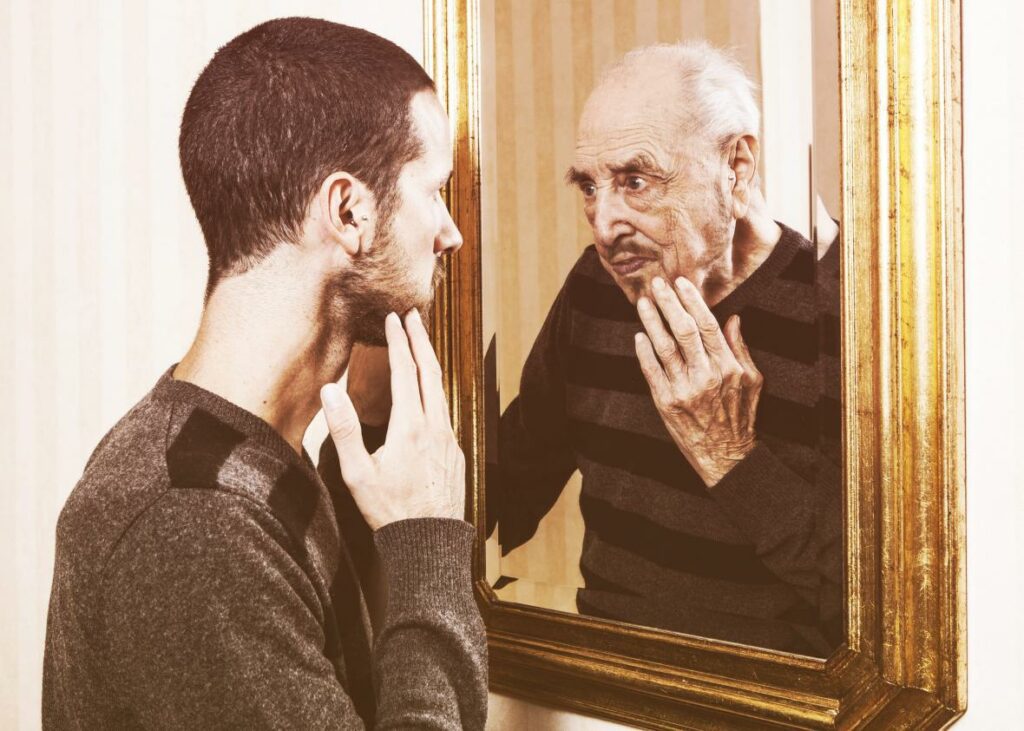
<figure class="wp-block-image size-large"><img loading="lazy" decoding="async" width="1024" height="731" src="https://humanefutureofwork.com/wp-content/uploads/2022/01/death-mirror-1024x731.jpeg" alt="" class="wp-image-2769" srcset="https://humanefutureofwork.com/wp-content/uploads/2022/01/death-mirror-1024x731.jpeg 1024w, https://humanefutureofwork.com/wp-content/uploads/2022/01/death-mirror-300x214.jpeg 300w, https://humanefutureofwork.com/wp-content/uploads/2022/01/death-mirror-768x548.jpeg 768w, https://humanefutureofwork.com/wp-content/uploads/2022/01/death-mirror-1170x835.jpeg 1170w, https://humanefutureofwork.com/wp-content/uploads/2022/01/death-mirror-585x417.jpeg 585w, https://humanefutureofwork.com/wp-content/uploads/2022/01/death-mirror.jpeg 1180w" sizes="(max-width: 1024px) 100vw, 1024px" /><figcaption class="wp-element-caption">Is the older you still you? / Photo from tommasolizzul/Thinkstock</figcaption></figure>


<p>The only thing that makes me, me, is that I was born in this body, and since then, I have been having my experiences and thoughts and remembering them. I could have been born in someone else’s body. I could have been one of the women cleaning my staircase.</p>


<p>I believe I deserve love and respect for the mere fact that I exist and I am a human being. Ergo, the same should apply to everybody else.</p>


<p>I should try to love everybody. I should feel loving kindness, compassion and acceptance for anybody.&nbsp;</p>


<p>But should I?</p>


<h2 class="wp-block-heading" id="h-unconditional-positive-regard-or-unconditional-love-for-everybody">Unconditional positive regard or unconditional love for everybody?</h2>


<p>Humanistic coaches and psychologists have&nbsp;<a target="_blank" href="https://en.wikipedia.org/wiki/Unconditional_positive_regard" rel="noreferrer noopener">unconditional positive regard</a>&nbsp;for their clients. They accept and support them regardless of what they say and what they do. For the mere fact of being human, they deserve that acceptance and support, or so goes their thinking.&nbsp;</p>


<p>Unconditional positive regard is an instrumental part of humanistic coaching. It is one of the main factors making the coaching work. The premise is that as the coachees perceive they are being accepted and positively regarded by a significant other, they will accept themselves and will feel freer to pursue their <a href="https://humanefutureofwork.com/is-self-actualisation-the-secret-to-a-happy-life/" target="_blank" rel="noreferrer noopener">self-actualising tendencies</a> and reach their full potential.</p>


<p>Could we translate this into unconditional love? Could we love everybody unconditionally, just because they are human and worthy of love?</p>


<p>Love is too strong a word. If I love everybody, then what is the emotion I reserve for the people closest to me? Stronger love, maybe. But I’m not entirely convinced by this argument.</p>


<p>I cannot really love, with genuine love, anybody I cross in the street. I just can’t. This would dilute the meaning of love. It is too important and powerful a concept to be extended to everybody.</p>


<p>Love may be too strong a word, but we could learn from humanistic coaches and therapists and start having an unconditional positive regard for all the people around us.&nbsp;</p>


<p>That I can do.</p>


<h2 class="wp-block-heading" id="h-free-will-and-the-deterministic-trap">Free will and the deterministic trap</h2>


<p>I can hear people complaining, “What happens with nazis, child molesters, rapists, criminals and all the people voting for a rival political party? Do they also deserve unconditional positive regard?&#8221;</p>


<p>We cannot possibly have a positive regard for them. They are all terrible people (especially those voting differently from us!)</p>


<p>Well, we can, and we should.</p>


<p>Many thinkers argue that <a href="https://en.wikipedia.org/wiki/Free_will">free will</a> doesn’t exist; it’s an illusion. Our brains seem to act on their own accord and then justify our actions through <em>a posteriori</em> rationalisations. We may be living in a deterministic trap where we are not entirely free of our actions.</p>


<p>If you were born with the same genes, in the same family, had the same life experiences and were living in the same context as a criminal, would you have acted differently? Probably not. You would probably be a criminal, too.</p>


<p>You would be determined to act the same way, so you would carry out the same actions.</p>


<p>People deserve to be regarded positively and unconditionally. We need to try to understand other people, put ourselves in their shoes and see where they are coming from. That doesn’t mean we need to forgive them or condone all their behaviours or that they should be free to roam and do harm to others.</p>


<p>Our actions have consequences, after all.</p>


<h2 class="wp-block-heading" id="h-building-a-better-future">Building a better future</h2>


<p>I don’t love everybody, but I try to have a positive regard for all. I could have been that other person after all.</p>


<p>What would happen if everybody did the same?</p>


<p>Perhaps we would create a decadent society of softies where everything goes, and a few cynics dominate the others, but I doubt it. I think we would be living in a better society, a more empathetic and harmonious one.&nbsp;</p>


<p><a target="_blank" href="https://humanefutureofwork.com/why-a-humane-future-of-work/" rel="noreferrer noopener">We build a better future through our actions</a>, but also through our attitudes and emotions. I choose love over all other emotions. Even if I won’t be able to fully love someone who has hurt me or my family, I will try to understand them and accept them as they are.&nbsp;</p>


<p>I will have an unconditional positive regard towards them. I will do the same for everybody else around me, and I encourage you to do the same.&nbsp;</p>


<p>We will then live in a better world, and you will probably feel better about it, too.</p>


<p></p>


<h3 class="wp-block-heading" id="h-join-the-newsletter-to-get-more-content-like-this"><a href="https://humanefutureofwork.com/stay-updated/">Join the Newsletter to get more content like this</a></h3>
<p>The post <a href="https://humanefutureofwork.com/i-could-be-anybody-so-i-love-everybody/">I could be anybody, so I love everybody</a> appeared first on <a href="https://humanefutureofwork.com">Humane Future of Work</a>.</p>
]]></content>
		
					<link rel="replies" type="text/html" href="https://humanefutureofwork.com/i-could-be-anybody-so-i-love-everybody/?utm_source=rss&#038;utm_medium=rss&#038;utm_campaign=i-could-be-anybody-so-i-love-everybody#comments" thr:count="0" />
			<link rel="replies" type="application/atom+xml" href="https://humanefutureofwork.com/i-could-be-anybody-so-i-love-everybody/feed/atom/" thr:count="0" />
			<thr:total>0</thr:total>
			</entry>
		<entry>
		<author>
			<name>Iker Urrutia</name>
					</author>

		<title type="html"><![CDATA[Existential Coaching: what is it?]]></title>
		<link rel="alternate" type="text/html" href="https://humanefutureofwork.com/existential-coaching-what-is-it/?utm_source=rss&#038;utm_medium=rss&#038;utm_campaign=existential-coaching-what-is-it" />

		<id>https://humanefutureofwork.com/?p=3971</id>
		<updated>2023-12-04T10:33:03Z</updated>
		<published>2023-11-08T07:44:14Z</published>
		<category scheme="https://humanefutureofwork.com/" term="Coaching" /><category scheme="https://humanefutureofwork.com/" term="coaching" />
		<summary type="html"><![CDATA[<p>Existential coaching is a coaching approach with depth that focuses on the big questions of life: death, uncertainty, anxiety and meaning.</p>
<p>The post <a href="https://humanefutureofwork.com/existential-coaching-what-is-it/">Existential Coaching: what is it?</a> appeared first on <a href="https://humanefutureofwork.com">Humane Future of Work</a>.</p>
]]></summary>

					<content type="html" xml:base="https://humanefutureofwork.com/existential-coaching-what-is-it/?utm_source=rss&#038;utm_medium=rss&#038;utm_campaign=existential-coaching-what-is-it"><![CDATA[
<h2 class="wp-block-heading" id="h-existential-coaching-is-a-coaching-approach-with-depth-that-focuses-on-the-big-questions-of-life-death-uncertainty-anxiety-and-meaning">Existential coaching is a coaching approach with depth that focuses on the big questions of life: death, uncertainty, anxiety and meaning.</h2>


<p>In&nbsp;<a target="_blank" href="https://humanefutureofwork.com/a-masters-and-a-new-focus/" rel="noreferrer noopener">my last post</a>, I wrote about my growing interest in existential coaching, an approach to coaching I wasn’t familiar with but which had picked up my curiosity. I have researched it and now know a bit more about it, so I’d like to share with you what I learned.</p>


<h2 class="wp-block-heading" id="h-existential-coaching-is-based-on-existential-philosophy"><strong>Existential Coaching is based on Existential Philosophy</strong></h2>


<blockquote class="wp-block-quote is-layout-flow wp-block-quote-is-layout-flow">
<p>“If he comes to you asking for advice, he has already chosen a course of action. In practical terms, I could very well have given him advice. But since his goal was freedom, I wanted him to be free to decide.” </p>
<cite>Jean-Paul Sartre,&nbsp;<a href="https://en.wikipedia.org/wiki/Existentialism_Is_a_Humanism" target="_blank" rel="noreferrer noopener">Existentialism is a Humanism</a></cite></blockquote>


<p>A student asked Sartre for advice on his dilemma: should he go to war to avenge his brother’s death or stay with his mother? As any good existential coach would have done in his place, Sartre decided not to give him the advice he sought and to let him exercise his freedom.</p>


<p>Sartre was an existential philosopher, playwright, writer, political activist and many other things, but not a coach, not even an existential one. Apart from sports coaching, other types of coaching did not become widely used until the 80s, while the existential sort did not get traction until the 2000s, well past Sartre’s death in 1980.&nbsp;</p>


<p>Sartre was not an existential coach but had, together with other philosophers like Kierkegaard, Heidegger, Husserl, or Nietzsche, or writers like Camus or Dostoevsky, an immense influence on existential coaching, as this is based, like existential therapy before it, on the principles of existentialism.</p>


<p>Existential coaching has a philosophical foundation but with a pragmatic approach: to help clients live more deliberate and freer lives.</p>


<p>Existential coaches believe in the freedom of individuals to forge their lives, so no single methodology works for all. There is not a unified framework applicable to all existential coaches. Like their philosophical forefathers, they are diverse and unique, but they do share their focus on particular themes: relatedness, uncertainty, anxiety (especially of the existential sort), death and temporality, meaning and meaninglessness, absurdity, freedom, choice and authenticity.</p>


<p>These are universal themes. You don’t need to be an existentialist to ponder about them. I wrote about&nbsp;<a target="_blank" href="https://humanefutureofwork.com/you-have-been-dead-before/" rel="noreferrer noopener">death</a>,&nbsp;<a target="_blank" href="https://humanefutureofwork.com/the-time-we-have-left/" rel="noreferrer noopener">temporality</a>, or&nbsp;<a target="_blank" href="https://humanefutureofwork.com/the-meaning-of-life/" rel="noreferrer noopener">the meaning of life</a>&nbsp;a while back already, and that doesn’t make me an existentialist, far from it.</p>


<h2 class="wp-block-heading" id="h-the-work-of-the-existential-coach"><strong>The work of the existential coach</strong></h2>


<p>An existential coach will explore these themes and the client’s values in the four dimensions of existence defined by Heidegger: the physical (umwelt), the social (mitwelt), the personal (eigenwelt) and the spiritual (uberwelt). By covering all these dimensions, they make sure they review the client’s worldview from a broad perspective, and they don’t miss anything during this exploration. </p>


<figure class="wp-block-gallery has-nested-images columns-default is-cropped wp-block-gallery-2 is-layout-flex wp-block-gallery-is-layout-flex">
<figure class="wp-block-image size-full"><img loading="lazy" decoding="async" width="276" height="183" data-id="3975" src="https://humanefutureofwork.com/wp-content/uploads/2023/11/Existential-dimensions.jpeg" alt="" class="wp-image-3975" srcset="https://humanefutureofwork.com/wp-content/uploads/2023/11/Existential-dimensions.jpeg 276w, https://humanefutureofwork.com/wp-content/uploads/2023/11/Existential-dimensions-263x175.jpeg 263w" sizes="(max-width: 276px) 100vw, 276px" /><figcaption class="wp-element-caption">The Existential Dimensions / Taken from van Deurzen, Emmy, &#8220;Existential Perspectives on Coaching&#8221;</figcaption></figure>
</figure>


<p>Like in other humanistic coaching approaches, existential coaches believe that their clients have the necessary resources within themselves and the self-actualisation tendencies to find the best solutions for them so that they will put the client at the centre of the session, but they will instil a clearer direction than, for example, person-centred coaches (in person-centred coaching, the coach mainly reflects what she hears to the client, doesn’t guide through questions), by framing the conversation within the existential themes mentioned above and the four existential dimensions.&nbsp;</p>


<blockquote class="wp-block-quote is-layout-flow wp-block-quote-is-layout-flow">
<p>“The most common form of despair is not being who you are.”&nbsp;</p>
<cite>Soren Kierkegaard</cite></blockquote>


<p>Not being who you are, not being authentic, is one of the biggest sins for existentialists. Existential coaches help clients understand who they are and what gives meaning to their lives. They believe life is meaningless and absurd, except for the meaning we decide to give it. There is no meaning of life, but we can find meaning in life.&nbsp;&nbsp;</p>


<p>Existential coaches explore these and other profound themes like death, freedom, anxiety, uncertainty and relatedness. It is an approach with depth, where clients are pushed to look into their inner worlds and grapple with paradoxes. This depth is arguably its biggest strength.&nbsp;</p>


<p>Existential coaching may not be the best approach for learning specific skills, but it is one of the most profound coaching approaches, best suited for clients to gain self-knowledge and find meaning, manage life transitions or face major life decisions.</p>


<h2 class="wp-block-heading" id="h-existence-precedes-essence-but-does-it"><strong>Existence precedes essence, but does it?</strong></h2>


<p>“Existence precedes essence”.</p>


<p>Sartre, Existentialism is a Humanism</p>


<p>Sartre thought that this was the first principle of existentialism. It means that human beings build their essence through their decisions and choices. They exist before they can conceive who they are. They are free to develop their essence. This is why freedom is one of the main themes of existentialism.&nbsp;</p>


<p>We are all free to do whatever we want as long as we assume the consequences. You are free to leave that job you don’t like or your partner for twenty years, as long as you are OK with being jobless or single. We are not forced to do anything; we set our own limits. Freedom brings with it responsibility. That’s why Sartre famously said that we are all “condemned to be free”.&nbsp;</p>


<p>This is the most liberating aspect of existentialism, which, despite its gloomy and dark fame, is an optimistic and empowering philosophy.&nbsp;</p>


<p>However, if “existence precedes essence” is the foundation of the entire existential edifice, it was built on shaky biological, psychological, and philosophical grounds.&nbsp;</p>


<p>Biologists and psychologists are still figuring out how much of our personality is due to our genetic makeup or life experiences, but they seem to agree that&nbsp;<a target="_blank" href="https://michigantoday.umich.edu/2022/12/16/nature-vs-nurture-its-both/#:~:text=From%20a%20scientific%20perspective%2C%20%E2%80%9Cnature,environmental%E2%80%9D%20factors%20on%20these%20traits." rel="noreferrer noopener">both nature and nurture play a part</a>, which means that at least part of our “essence” is inherited, not defined by us.&nbsp;<a target="_blank" href="https://en.wikipedia.org/wiki/Attachment_theory" rel="noreferrer noopener">Attachment theory</a>&nbsp;states that another important part is developed in the early years of life when we are too young to have a real choice about it.&nbsp;</p>


<p>Also, it is unclear&nbsp;<a target="_blank" href="https://en.wikipedia.org/wiki/Free_will" rel="noreferrer noopener">whether free will exists</a>. If we are not free to choose, how can we create our essence through our actions? How can we be “condemned to be free”?</p>


<p>We could argue that it does not matter whether a coaching client&nbsp;<em>is</em>&nbsp;really free to define who they are. As long as they&nbsp;<em>believe</em>&nbsp;they are free, they might find existential coaching helpful.</p>


<h2 class="wp-block-heading" id="h-no-goals-no-solutions"><strong>No goals, no solutions?</strong></h2>


<p>Unlike many other coaching approaches, existential coaching is not a solution or goal-focused approach. There is a&nbsp;<a target="_blank" href="https://sk.sagepub.com/books/mindful-inquiry-in-social-research/n7.xml#:~:text=Phenomenological%20Inquiry-,Phenomenological%20inquiry,intellect%20and%20society%20as%20possible." rel="noreferrer noopener">phenomenological enquiry</a>&nbsp;of the client’s worldview, values and the existential themes and paradoxes preoccupying them, so it lacks the structure and goal orientation of most other approaches.&nbsp;</p>


<p>That doesn’t mean that there are no solutions or goals achieved. All clients come to a coaching assignment with a problem, aspiration or aim, even if not explicitly stated. They want to achieve something; otherwise, they wouldn’t go through the coaching process.&nbsp;</p>


<p>In existential coaching, they may not state clearly their goals, and the coach and the client wouldn’t spend the time they would spend on other approaches to define well the goals of the assignment. That doesn’t mean it doesn’t work or it doesn’t help clients find solutions to their problems and live more fulfilling lives.&nbsp;</p>


<p>Existential coaching is a relatively recent approach, and little research has been carried out about its effectiveness as a coaching practice, but it does seem to work in certain situations and for certain types of clients.</p>


<p>As mentioned, it won’t necessarily work on coaching processes focused on building specific skills, but it can be very effective in transformational or developmental coaching. It can help clients know themselves better, find meaning in their lives, manage the&nbsp;<a target="_blank" href="https://www.psychologytoday.com/intl/blog/the-cube/202212/the-profound-challenge-of-existential-anxiety" rel="noreferrer noopener">existential anxiety</a>&nbsp;we all seem to live with and live happier lives.&nbsp;</p>


<p>Despite its purely Western origins (mainly from European men), existentialism aims to deal with universal themes. We all think about our death and temporality in this life, what it means to be free or authentic. In that sense, existential coaching can help us all better grapple with these issues and live lives that are aligned with our purpose and values.&nbsp;</p>


<p>I have started practising it with some of my clients, with their consent. Existentialism is not for everybody, but it works well with some people, especially with the most philosophically minded or reflective ones.&nbsp;</p>


<p>I will continue learning more about it and practising it. After all, we all think about existential themes once in a while, and I am no exception. Knowing more about it will allow me to be a better coach, but more importantly, to deal better with my own existential issues.&nbsp;</p>


<h3 class="wp-block-heading" id="h-join-the-newsletter-to-get-more-content-like-this"><a href="https://humanefutureofwork.com/stay-updated/">Join the Newsletter to get more content like this</a></h3>
<p>The post <a href="https://humanefutureofwork.com/existential-coaching-what-is-it/">Existential Coaching: what is it?</a> appeared first on <a href="https://humanefutureofwork.com">Humane Future of Work</a>.</p>
]]></content>
		
					<link rel="replies" type="text/html" href="https://humanefutureofwork.com/existential-coaching-what-is-it/?utm_source=rss&#038;utm_medium=rss&#038;utm_campaign=existential-coaching-what-is-it#comments" thr:count="0" />
			<link rel="replies" type="application/atom+xml" href="https://humanefutureofwork.com/existential-coaching-what-is-it/feed/atom/" thr:count="0" />
			<thr:total>0</thr:total>
			</entry>
		<entry>
		<author>
			<name>Iker Urrutia</name>
					</author>

		<title type="html"><![CDATA[A Master’s and a new focus]]></title>
		<link rel="alternate" type="text/html" href="https://humanefutureofwork.com/a-masters-and-a-new-focus/?utm_source=rss&#038;utm_medium=rss&#038;utm_campaign=a-masters-and-a-new-focus" />

		<id>https://humanefutureofwork.com/?p=3962</id>
		<updated>2023-12-01T09:10:45Z</updated>
		<published>2023-09-26T11:19:37Z</published>
		<category scheme="https://humanefutureofwork.com/" term="Personal Growth" /><category scheme="https://humanefutureofwork.com/" term="coaching" />
		<summary type="html"><![CDATA[<p>I started a Master’s in Coaching, and that’s giving my life and this blog a new focus.</p>
<p>The post <a href="https://humanefutureofwork.com/a-masters-and-a-new-focus/">A Master’s and a new focus</a> appeared first on <a href="https://humanefutureofwork.com">Humane Future of Work</a>.</p>
]]></summary>

					<content type="html" xml:base="https://humanefutureofwork.com/a-masters-and-a-new-focus/?utm_source=rss&#038;utm_medium=rss&#038;utm_campaign=a-masters-and-a-new-focus"><![CDATA[
<p>Photo by <a href="https://unsplash.com/@sometimesiedit?utm_source=unsplash&amp;utm_medium=referral&amp;utm_content=creditCopyText">Dorin Seremet</a> on <a href="https://unsplash.com/photos/5iU2A4fW6YA?utm_source=unsplash&amp;utm_medium=referral&amp;utm_content=creditCopyText">Unsplash</a></p>


<h2 class="wp-block-heading" id="h-i-started-a-master-s-in-coaching-and-that-s-giving-my-life-and-this-blog-a-new-focus"><strong>I started a Master’s in Coaching, and that’s giving my life and this blog a new focus</strong></h2>


<p>At the beginning of September, I started a Master’s in Coaching at the University of Cambridge.</p>


<p>If you have been reading this blog, you should know by now that I am passionate about coaching and personal growth (of others, but also mine). I have been looking at options for furthering my education in coaching for a while now, and this program from the University of Cambridge checked all the boxes.&nbsp;</p>


<p>On top of everything else, I get to go to Cambridge for a few days every semester.&nbsp;</p>


<p>I am very excited about this new adventure, but the next couple of years will be demanding. They will be insightful and stimulating but also challenging.&nbsp;</p>


<p>So I went to Cambridge to spend a hot, sweaty and intellectually stimulating week among 15 strangers who will be my travel companions for the next two years. A few of them will become good friends, too.&nbsp;</p>


<figure class="wp-block-image size-large"><img loading="lazy" decoding="async" width="1024" height="768" src="https://humanefutureofwork.com/wp-content/uploads/2023/09/IMG_3744-1024x768.jpeg" alt="" class="wp-image-3965" srcset="https://humanefutureofwork.com/wp-content/uploads/2023/09/IMG_3744-1024x768.jpeg 1024w, https://humanefutureofwork.com/wp-content/uploads/2023/09/IMG_3744-300x225.jpeg 300w, https://humanefutureofwork.com/wp-content/uploads/2023/09/IMG_3744-768x576.jpeg 768w, https://humanefutureofwork.com/wp-content/uploads/2023/09/IMG_3744-1536x1152.jpeg 1536w, https://humanefutureofwork.com/wp-content/uploads/2023/09/IMG_3744-2048x1536.jpeg 2048w, https://humanefutureofwork.com/wp-content/uploads/2023/09/IMG_3744-1920x1440.jpeg 1920w, https://humanefutureofwork.com/wp-content/uploads/2023/09/IMG_3744-1170x878.jpeg 1170w, https://humanefutureofwork.com/wp-content/uploads/2023/09/IMG_3744-585x439.jpeg 585w" sizes="(max-width: 1024px) 100vw, 1024px" /><figcaption class="wp-element-caption">Walking around Cambridge</figcaption></figure>


<h2 class="wp-block-heading" id="h-coaching-psychology">Coaching Psychology</h2>


<p>This first unit was all about coaching psychology, which is the branch of psychology that concerns itself with studying coaching.</p>


<p>Coaching is a multidisciplinary practice that takes from many different areas, such as philosophy, anthropology, sociology, management, and sports, but psychology is arguably the most important one. After all, coaching is about enacting change at the rational, emotional, and behavioural levels of an individual or a team, so there is a lot of psychology involved.</p>


<p>If any science can give a more evidence-based and scientific approach to coaching, that is psychology.</p>


<p>I studied humanities and business, not psychology, so there are still many things for me to learn about how to use psychology best to improve my coaching.&nbsp;&nbsp;</p>


<p>In that sense, the entire week was eye-opening. I am still assimilating what I learned, but I have already started using new approaches in my coaching and feel confident that I am already a (slightly) better coach.&nbsp;</p>


<h2 class="wp-block-heading" id="h-from-freud-to-positive-psychology">From Freud to Positive Psychology…</h2>


<p>When I trained as a coach a few years ago, it was mainly on ontological coaching, which focuses on the being of the coachee in the world, with particular attention to language, emotions and the body.</p>


<p>Since then, I’ve been reading about other approaches, but I hadn’t realised how many different ways we coaches have to accompany our clients in their journey towards self-knowledge and growth.</p>


<p>For example, cognitive behavioural coaching (CBC) centres around cognitive and behavioural processes to help problem-solving and enact change on the coachee.</p>


<p>If you are more inclined towards the Freudian school of thought, you could go with psychodynamic coaching, which focuses on the subconscious and the defences we unconsciously put against others. These defences are usually helpful, but they can also be limiting. A psychodynamic coach will help their clients undo the problems created by the incorrect use of those defences.&nbsp;</p>


<p>Then you have the humanistic branch of psychology, which is well suited for coaching, as it focuses more on the human being as an empowered and able individual who has all the answers she needs within herself. This branch includes Gestalt coaching based on Gestalt therapy, the ontological coaching I was so familiar with, the person-centred approach, or Maslow and&nbsp;<a target="_blank" href="https://humanefutureofwork.com/is-self-actualisation-the-secret-to-a-happy-life/" rel="noreferrer noopener">the focus on self-actualisation</a>.</p>


<p>What I found most intriguing, however, is another humanistic school of thought, and that is existentialism applied to coaching. Existential coaches help their clients untangle the Big Questions of life: <a href="https://humanefutureofwork.com/you-have-been-dead-before/" target="_blank" rel="noreferrer noopener">death</a>, temporality, freedom and choice, <a href="https://humanefutureofwork.com/the-purposeful-leader-5-essential-characteristics-to-be-one/" target="_blank" rel="noreferrer noopener">purpose</a> and <a href="https://humanefutureofwork.com/the-meaning-of-life/" target="_blank" rel="noreferrer noopener">the meaning of life</a>. These are all topics I am interested in (who isn’t?), so I will be researching and learning more about this type of coaching. I will definitely be writing about <a href="https://humanefutureofwork.com/existential-coaching-what-is-it/">existential coaching</a> moving forward.</p>


<p>Last but not least, we have positive psychology, which is the branch of psychology that focuses on what is right with human beings: well-being, happiness and fulfilment. This has been very popular lately, also among coaches. I have heard coaching defined as the applied and practical arm of positive psychology.&nbsp;</p>


<p>Coaching is much more than that, but the definition has its nugget of truth. We coaches also focus on what is right in the human psyche, and we try to make it even more right.&nbsp;</p>


<h2 class="wp-block-heading" id="h-new-focus">New focus</h2>


<p>All this post is to say that I will focus on coaching in the next couple of years. I will be reading, studying and practising more coaching than ever.&nbsp;</p>


<p>This will impact the rest of my life, including this blog.</p>


<p>This blog was originally aimed at creating a more&nbsp;<a target="_blank" href="https://humanefutureofwork.com/why-a-humane-future-of-work/" rel="noreferrer noopener">humane future of work</a>. I have written a lot about&nbsp;<a target="_blank" href="https://humanefutureofwork.com/the-6-most-important-workplace-trends-for-2030-and-beyond/" rel="noreferrer noopener">future trends</a>&nbsp;and&nbsp;<a target="_blank" href="https://humanefutureofwork.com/possible-futures-life-in-the-age-of-abundance/" rel="noreferrer noopener">scenarios of the future</a>.&nbsp;</p>


<p>I have also written a lot about leadership,&nbsp;<a target="_blank" href="https://humanefutureofwork.com/the-4-leadership-qualities-of-the-future-leader/" rel="noreferrer noopener">the qualities of the future leader</a>,&nbsp;<a target="_blank" href="https://humanefutureofwork.com/a-simple-guide-to-coaching/" rel="noreferrer noopener">coaching</a>&nbsp;and&nbsp;<a target="_blank" href="https://humanefutureofwork.com/category/personal-growth/" rel="noreferrer noopener">personal growth</a>&nbsp;in general because they are linked to creating a better future. We will only create a better society if each of us grows and becomes a better person and if we are led by leaders with the correct values and qualities.</p>


<p>I will continue writing about future trends and the future of work. This is still the focus of this website, but it is only natural that I will focus more on coaching and personal growth. Most of my reading and thinking will be in this area, so it will be difficult for me to focus on other areas. I will be learning a lot, and I hope to be able to transmit my learnings here.</p>


<p>I hope you will join me on my journey towards greater self-awareness, learning and growth.&nbsp;</p>


<p>Enjoy the ride.&nbsp;</p>


<p></p>


<h3 class="wp-block-heading" id="h-join-the-newsletter-to-get-more-content-like-this"><a href="https://humanefutureofwork.com/stay-updated/">Join the Newsletter to get more content like this</a></h3>
<p>The post <a href="https://humanefutureofwork.com/a-masters-and-a-new-focus/">A Master’s and a new focus</a> appeared first on <a href="https://humanefutureofwork.com">Humane Future of Work</a>.</p>
]]></content>
		
					<link rel="replies" type="text/html" href="https://humanefutureofwork.com/a-masters-and-a-new-focus/?utm_source=rss&#038;utm_medium=rss&#038;utm_campaign=a-masters-and-a-new-focus#comments" thr:count="0" />
			<link rel="replies" type="application/atom+xml" href="https://humanefutureofwork.com/a-masters-and-a-new-focus/feed/atom/" thr:count="0" />
			<thr:total>0</thr:total>
			</entry>
		<entry>
		<author>
			<name>Iker Urrutia</name>
					</author>

		<title type="html"><![CDATA[Growth Mindset: What Exactly Is It and How Can You Develop It?]]></title>
		<link rel="alternate" type="text/html" href="https://humanefutureofwork.com/growth-mindset-what-exactly-is-it-and-how-can-you-develop-it/?utm_source=rss&#038;utm_medium=rss&#038;utm_campaign=growth-mindset-what-exactly-is-it-and-how-can-you-develop-it" />

		<id>https://humanefutureofwork.com/?p=3956</id>
		<updated>2023-12-04T10:34:18Z</updated>
		<published>2023-08-23T06:19:14Z</published>
		<category scheme="https://humanefutureofwork.com/" term="Personal Growth" /><category scheme="https://humanefutureofwork.com/" term="growth mindset" />
		<summary type="html"><![CDATA[<p>Growth and fixed mindset, what are they? And how can you develop a growth mindset?</p>
<p>The post <a href="https://humanefutureofwork.com/growth-mindset-what-exactly-is-it-and-how-can-you-develop-it/">Growth Mindset: What Exactly Is It and How Can You Develop It?</a> appeared first on <a href="https://humanefutureofwork.com">Humane Future of Work</a>.</p>
]]></summary>

					<content type="html" xml:base="https://humanefutureofwork.com/growth-mindset-what-exactly-is-it-and-how-can-you-develop-it/?utm_source=rss&#038;utm_medium=rss&#038;utm_campaign=growth-mindset-what-exactly-is-it-and-how-can-you-develop-it"><![CDATA[
<p>Photo by <a href="https://unsplash.com/@jasonhogan?utm_source=unsplash&amp;utm_medium=referral&amp;utm_content=creditCopyText">Jason Hogan</a> on <a href="https://unsplash.com/photos/YyFwUKzv5FM?utm_source=unsplash&amp;utm_medium=referral&amp;utm_content=creditCopyText">Unsplash</a></p>


<h2 class="wp-block-heading" id="h-intro">Intro</h2>


<p>The growth mindset is one of the most powerful concepts related to human achievement and potential, but what is it exactly? And can you develop and attain it?</p>


<p>The answer to the first question will require some more time, so please bear with me, but the second one has a short and simple one: yes, you can.</p>


<p>Of course it is possible; that’s the whole point of the growth mindset, that we can always grow, develop and learn. We will also look at how to do it further below.</p>


<p>But first, let’s look at what it is.</p>


<h2 class="wp-block-heading" id="h-what-is-the-growth-mindset">What is the growth mindset?</h2>


<p>The American psychologist Carol S. Dweck coined the term growth mindset in his famous work&nbsp;<a target="_blank" href="https://www.goodreads.com/book/show/40745.Mindset" rel="noreferrer noopener">Mindset: The New Psychology of Success</a>&nbsp;in 2006.</p>


<p>Since then, the term has been widely used in psychology,&nbsp;<a target="_blank" href="https://humanefutureofwork.com/how-can-future-leaders-develop-their-personal-growth-skills/" rel="noreferrer noopener">personal growth</a>&nbsp;and leadership. I have also mentioned in several articles (for example,&nbsp;<a target="_blank" href="https://humanefutureofwork.com/how-can-future-leaders-develop-their-personal-growth-skills/" rel="noreferrer noopener">here</a>,&nbsp;<a target="_blank" href="https://humanefutureofwork.com/how-coaching-exercises-can-help-you-develop-into-a-successful-future-leader/" rel="noreferrer noopener">here</a>&nbsp;and&nbsp;<a target="_blank" href="https://humanefutureofwork.com/is-self-actualisation-the-secret-to-a-happy-life/" rel="noreferrer noopener">here</a>).</p>


<p>Dweck studied pupils at a young age and argued that people could be placed in a continuum based on their views on where ability comes from. On one end of the spectrum were those with a fixed mindset, who believed ability and intelligence were innate and could not be developed. On the other end, you would find those with a growth mindset who thought ability could be learned and developed through practice and hard work.&nbsp;&nbsp;</p>


<p>This is a simple concept, but it has profound implications.&nbsp;</p>


<h3 class="wp-block-heading" id="h-the-fixed-mindset">The fixed mindset</h3>


<p>As shown in the diagram below, a fixed mindset makes people believe their intelligence is static. This makes them afraid to look stupid, so they will avoid challenges and suffer when they make mistakes or receive criticism. They will see errors as signs of their imperfect intelligence. They will equate an error to a failure.&nbsp;</p>


<p>Errors will be an attack on their very self and identity.&nbsp;</p>


<p>As a consequence, and this is the saddest of it all, people with a fixed mindset will plateau early and will not achieve their full potential.&nbsp;</p>


<div class="wp-block-image">
<figure class="aligncenter size-full"><img loading="lazy" decoding="async" width="438" height="647" src="https://humanefutureofwork.com/wp-content/uploads/2023/08/Mindset-Nigel-Holmes.jpeg" alt="" class="wp-image-3958" srcset="https://humanefutureofwork.com/wp-content/uploads/2023/08/Mindset-Nigel-Holmes.jpeg 438w, https://humanefutureofwork.com/wp-content/uploads/2023/08/Mindset-Nigel-Holmes-203x300.jpeg 203w" sizes="(max-width: 438px) 100vw, 438px" /><figcaption class="wp-element-caption">The two mindsets / Nigel Holmes</figcaption></figure></div>


<h3 class="wp-block-heading" id="h-the-growth-mindset">The growth mindset</h3>


<p>Individuals with a growth mindset, on the other hand, believe that intelligence and ability can be developed, so they will continuously seek opportunities to develop them further.&nbsp;</p>


<p>They will face challenges willingly, see errors as a necessary part of growth and learning, and accept feedback not as criticism or an attack to their self, but as a gift that helps them become a better version of themselves.&nbsp;</p>


<p>They grow and achieve ever-greater levels of achievement, thus getting closer&nbsp;<a target="_blank" href="https://humanefutureofwork.com/is-self-actualisation-the-secret-to-a-happy-life/" rel="noreferrer noopener">to self-actualisation</a>, happiness and fulfilment.&nbsp;</p>


<h2 class="wp-block-heading" id="h-exigence-and-perfectionism-vs-excellence">Exigence and Perfectionism vs Excellence</h2>


<p>When coaching my clients, one of the most prevalent issues is exigence and its close cousin, perfectionism, which are often linked to a fixed mindset.&nbsp;&nbsp;</p>


<p>When someone is living in exigence and perfectionism, they mix what they do with who they are. They are what they do, so if what they do is not perfect, their being, and therefore their identity, are flawed.</p>


<p>Thus, not doing something perfectly becomes proof of them being flawed and imperfect. This is a race that can never be won, as we are all innately imperfect, and there will always be things we lack or could have done better.&nbsp;</p>


<p>People living in exigence tend to look at what they are missing and lacking, not so much at what they have achieved. This is a recipe for chronic dissatisfaction and frustration.&nbsp;</p>


<p>These people become very self-demanding and excessively exigent with themselves and others. This may help them achieve certain notoriety in their professions, climb the corporate ladder and achieve what they think is success, but more often than not, it comes at a high price.</p>


<p>Like everything we do in coaching (and in life), what matters at the end of the day is if a certain belief, assumption, or behaviour helps or limits us. Exigence and perfectionism may be helpful in some cases, but in most situations, they will be limiting and should therefore be overcome and dealt with.</p>


<p>To do just that, I explore the concept of excellence with my coaching clients. Excellence is about recognising that none of us is perfect but that we can always improve and get better at something. It is about improving daily and seeing mistakes and challenges as learning opportunities. People seeking excellence focus more on what they have achieved than what they lacked or missed.&nbsp;</p>


<p>Excellence is about becoming the best version of yourself, about achieving self-realisation.&nbsp;</p>


<p>Exigence and perfectionism have clear links with a fixed mindset, whereas seeking excellence indicates someone with a growth mindset.</p>


<h2 class="wp-block-heading" id="h-a-personal-story-struggling-between-the-fixed-and-growth-mindsets">A personal story: struggling between the fixed and growth mindsets</h2>


<p>I read Dweck’s book a few years ago. As I often do in these cases, I identified myself with the positive concept and discarded the negative one as something alien to me. I thought I was a great exponent of the growth mindset. </p>


<p>But the more I read and thought about it, the more I realised that I often showed behaviours more linked to a fixed mindset.</p>


<p>I was supposed to be an intelligent kid since I went to school, and I thought that was innate. I realised that I often shied away from big challenges so I didn’t fail and prove that I wasn’t so smart after all.&nbsp;</p>


<p>What if I failed on a difficult task? People would see me for who I really was, someone winging it as he went along and not so intelligent after all. They would see that the emperor had no clothes and was parading fully naked.&nbsp;</p>


<p>I have had chronic impostor syndrome my entire life and a dread of being seen as what I really was: a flawed individual who didn’t know what he was doing.&nbsp;</p>


<p>Was I feeling this way all the time? No, of course not. I have faced some heavy challenges in my life, and I have grown and learned because of them.</p>


<p>Let’s not forget Dweck told us about a spectrum with two extremes. Some people will have a growth mindset most of the time, others will always have a fixed one, but most people will be somewhere in between and will have some growth and fixed mindset tendencies.&nbsp;</p>


<p>I am somewhere in the middle, but being aware of it is helping me to stop myself when I am being fixed and to inch slowly towards the growth side of the spectrum.</p>


<h2 class="wp-block-heading" id="h-how-to-develop-a-growth-mindset-in-4-steps">How to Develop a Growth Mindset in 4 steps</h2>


<p>Dweck tells us about four steps we need to take to develop a growth mindset.&nbsp;</p>


<h3 class="wp-block-heading" id="h-step-1-embrace-your-fixed-mindset">Step 1 – Embrace your fixed mindset</h3>


<p>Like me, you probably also have a mix of both fixed and growth mindsets. Admit that you have a bit of a fixed mindset, and do not castigate yourself for it.&nbsp;</p>


<p>Still, there is no need to let it show up as often as it does.&nbsp;</p>


<p>In Dweck’s words, “even though we have to accept that some fixed mindset dwells within, we do not have to accept how often it shows up and how much havoc it can wreak when it does.”</p>


<h3 class="wp-block-heading" id="h-step-2-become-aware-of-your-fixed-mindset-triggers">Step 2 – Become aware of your fixed mindset triggers</h3>


<p>What makes your fixed mindset flare and show up?&nbsp;</p>


<p>Is it when you are about to start a big project and self-doubt about your abilities starts to creep in?</p>


<p>Or is it when you are struggling and stuck with a particular task or project?</p>


<p>Or maybe when you have failed decisively on something? Lost a job, failed an exam, your partner left you…</p>


<p>Or perhaps when you find someone much better than you in an area you pride yourself on?</p>


<p>Many triggers push our fixed mindset to the surface. Discover yours and be especially mindful of them.</p>


<h3 class="wp-block-heading" id="h-step-3-give-your-fixed-mindset-persona-a-name">Step 3 – Give your fixed mindset persona a name</h3>


<p>This might look silly, but it works.&nbsp;</p>


<p>It will allow you to identify and label your fixed mindset persona when it shows up. It will increase your awareness of when you are behaving with a fixed mindset and help you overcome it.&nbsp;</p>


<h3 class="wp-block-heading" id="h-step-4-educate-your-fixed-mindset-persona">Step 4 – Educate your fixed mindset persona</h3>


<p>You are now aware of the triggers that push forward your fixed mindset persona and have given it a name. You are now familiar with it. The next step is to educate it every time it shows up.</p>


<p>If you have failed at something or have made a mistake, John, Linda, Alain, or however you decided to call your fixed mindset, will show up. You can tell your fixed mindset persona that you understand what they are trying to achieve, but they should let you give it a go. You may have made a mistake or failed, but you still think you have the ability to learn and get better at whatever you are attempting to do.</p>


<h2 class="wp-block-heading" id="h-the-power-of-yet">The power of YET</h2>


<p>You don’t have the ability or skill to do it YET, but you will have it eventually. We all have the capacity to learn and get better.</p>


<p>Yet is the key word here.&nbsp;</p>


<p>Someone in a fixed mindset will think they don’t have the ability to do something and will stop there. A person with a growth mindset, on the other hand, will realise this is temporary and that they don’t have that skill YET, but that with practice, hard work and time, they can get there.&nbsp;</p>


<p>Whenever you feel stuck, and your fixed mindset takes over, think about the power of yet. You may be stuck on something because you don’t know how to do it yet, but it is not impossible for you to get to a sufficient level of mastery.&nbsp;</p>


<p>Everything can be learned and developed with enough time and dedication. Everyone can develop a specific skill or ability given enough time.&nbsp;</p>


<p>That’s the biggest learning we can take from the growth mindset. It’s an important one.&nbsp;</p>


<p>You may not know how to do it yet, but you’ll get there.</p>


<h3 class="wp-block-heading" id="h-join-the-newsletter-to-get-more-content-like-this"><a href="https://humanefutureofwork.com/stay-updated/">Join the Newsletter to get more content like this</a></h3>
<p>The post <a href="https://humanefutureofwork.com/growth-mindset-what-exactly-is-it-and-how-can-you-develop-it/">Growth Mindset: What Exactly Is It and How Can You Develop It?</a> appeared first on <a href="https://humanefutureofwork.com">Humane Future of Work</a>.</p>
]]></content>
		
					<link rel="replies" type="text/html" href="https://humanefutureofwork.com/growth-mindset-what-exactly-is-it-and-how-can-you-develop-it/?utm_source=rss&#038;utm_medium=rss&#038;utm_campaign=growth-mindset-what-exactly-is-it-and-how-can-you-develop-it#comments" thr:count="2" />
			<link rel="replies" type="application/atom+xml" href="https://humanefutureofwork.com/growth-mindset-what-exactly-is-it-and-how-can-you-develop-it/feed/atom/" thr:count="2" />
			<thr:total>2</thr:total>
			</entry>
		<entry>
		<author>
			<name>Iker Urrutia</name>
					</author>

		<title type="html"><![CDATA[Emotions vs Rationality: which is better?]]></title>
		<link rel="alternate" type="text/html" href="https://humanefutureofwork.com/emotions-vs-rationality-which-is-better/?utm_source=rss&#038;utm_medium=rss&#038;utm_campaign=emotions-vs-rationality-which-is-better" />

		<id>https://humanefutureofwork.com/?p=3951</id>
		<updated>2023-12-04T10:35:10Z</updated>
		<published>2023-08-10T08:14:00Z</published>
		<category scheme="https://humanefutureofwork.com/" term="Personal Growth" /><category scheme="https://humanefutureofwork.com/" term="emotions" />
		<summary type="html"><![CDATA[<p>Emotions or our rational mind, which one is better? Our rational mind usually gets the good press, but emotions are as important. </p>
<p>The post <a href="https://humanefutureofwork.com/emotions-vs-rationality-which-is-better/">Emotions vs Rationality: which is better?</a> appeared first on <a href="https://humanefutureofwork.com">Humane Future of Work</a>.</p>
]]></summary>

					<content type="html" xml:base="https://humanefutureofwork.com/emotions-vs-rationality-which-is-better/?utm_source=rss&#038;utm_medium=rss&#038;utm_campaign=emotions-vs-rationality-which-is-better"><![CDATA[
<p>Photo by <a href="https://unsplash.com/@carolineveronez?utm_source=unsplash&amp;utm_medium=referral&amp;utm_content=creditCopyText">Caroline Veronez</a> on <a href="https://unsplash.com/photos/bbjmFMdWYfw?utm_source=unsplash&amp;utm_medium=referral&amp;utm_content=creditCopyText">Unsplash</a></p>


<h2 class="wp-block-heading" id="h-emotions-or-our-rational-mind-which-one-is-better-our-rational-mind-usually-gets-the-good-press-but-emotions-are-as-important">Emotions or our rational mind, which one is better? Our rational mind usually gets the good press, but emotions are as important. </h2>


<p>In the battle between emotions and rationality, which one ultimately shapes our destiny?</p>


<p>This is a false dichotomy.&nbsp;</p>


<p>We need both emotions and our rational minds to function well, but pitting them against each other is fashionable. In this fight between the two, rationality usually comes on top, at least in today’s modern way of looking at things.</p>


<p>We need to control our emotions, not be dominated by them. We even need to hide or disguise them. “Don’t be emotional!” we tell each other as if that were a bad thing.&nbsp;</p>


<p>I don’t want to pit emotions against our rational minds. It doesn’t need to be one OR the other. It can and should be one AND the other.</p>


<p>They complement each other, and they are both critical.</p>


<h2 class="wp-block-heading" id="h-the-importance-of-emotions">The importance of emotions</h2>


<p>Emotions are an essential part of human (and animal) life.&nbsp;</p>


<p>We can’t live a normal life without emotions. That’s how important they are.</p>


<p>Evolutionarily speaking,&nbsp;<a target="_blank" href="https://en.wikipedia.org/wiki/Evolution_of_emotion" rel="noreferrer noopener">emotions were part of our behavioural toolkit</a>&nbsp;well before the rational mind even existed. Many animal species feel emotions such as fear or anger or get attached to other members of their species with something akin to love.&nbsp;</p>


<p>Emotions helped our ancestors survive and thrive before they were humans. They still help us survive and thrive today.</p>


<p>As I explained in the post&nbsp;<a target="_blank" href="https://humanefutureofwork.com/we-need-to-talk-about-emotions/" rel="noreferrer noopener">We Need to Talk about Emotions</a>, all emotions serve a function, so at least in that sense, they are all positive.</p>


<p>Contrary to popular belief and indications from some management and self-help gurus, there are no positive or negative emotions. They are all helpful and useful.&nbsp;</p>


<p>Some emotions are more pleasant than others, but that’s all.</p>


<h2 class="wp-block-heading" id="h-our-rational-mind">Our rational mind</h2>


<p>Human beings are rational beings, or so we like to think.</p>


<p>We are the most rational of all animals. Our capacity to think rationally and logically distinguishes us from all other beings. We are capable of looking at different options and deciding the best course of action.</p>


<p>But is this really the case?</p>


<p>Some thinkers, like the famous podcaster, philosopher, meditator and neuroscientist Sam Harris,&nbsp;<a target="_blank" href="https://en.wikipedia.org/wiki/Free_Will_(book)" rel="noreferrer noopener">believe that human beings don’t have free will</a>&nbsp;and that free will is a mere illusion. Faced with the same choice under exactly the same circumstances, a hundred times out of a hundred, we will make the same decision.&nbsp;</p>


<p>With the same inputs, we will always have the same outputs. So then, where is our free will? The world seems to be a fully deterministic place for Harris and other thinkers.</p>


<p>The neurologist Benjamin Libet carried out some <a href="https://www.informationphilosopher.com/freedom/libet_experiments.html" target="_blank" rel="noreferrer noopener">now-famous experiments</a> in the early 80s that were seen as supporting this view. In these experiments, Libet and his team discovered that the subjects initiated some moves a few hundred milliseconds before their conscious mind was aware of the movement. Our brain asks our body parts to move before we are made aware of the action.  </p>


<figure class="wp-block-image size-large"><img loading="lazy" decoding="async" width="1024" height="683" src="https://humanefutureofwork.com/wp-content/uploads/2023/08/peter-conlan-LEgwEaBVGMo-unsplash-1024x683.jpg" alt="" class="wp-image-3954" srcset="https://humanefutureofwork.com/wp-content/uploads/2023/08/peter-conlan-LEgwEaBVGMo-unsplash-1024x683.jpg 1024w, https://humanefutureofwork.com/wp-content/uploads/2023/08/peter-conlan-LEgwEaBVGMo-unsplash-300x200.jpg 300w, https://humanefutureofwork.com/wp-content/uploads/2023/08/peter-conlan-LEgwEaBVGMo-unsplash-768x512.jpg 768w, https://humanefutureofwork.com/wp-content/uploads/2023/08/peter-conlan-LEgwEaBVGMo-unsplash-1536x1024.jpg 1536w, https://humanefutureofwork.com/wp-content/uploads/2023/08/peter-conlan-LEgwEaBVGMo-unsplash-2048x1365.jpg 2048w, https://humanefutureofwork.com/wp-content/uploads/2023/08/peter-conlan-LEgwEaBVGMo-unsplash-1920x1280.jpg 1920w, https://humanefutureofwork.com/wp-content/uploads/2023/08/peter-conlan-LEgwEaBVGMo-unsplash-1170x780.jpg 1170w, https://humanefutureofwork.com/wp-content/uploads/2023/08/peter-conlan-LEgwEaBVGMo-unsplash-585x390.jpg 585w, https://humanefutureofwork.com/wp-content/uploads/2023/08/peter-conlan-LEgwEaBVGMo-unsplash-263x175.jpg 263w" sizes="(max-width: 1024px) 100vw, 1024px" /><figcaption class="wp-element-caption">Does free will exist? Did you jump because you wanted to beforehand? / Photo by <a href="https://unsplash.com/@peterconlan?utm_source=unsplash&amp;utm_medium=referral&amp;utm_content=creditCopyText">Peter Conlan</a> on <a href="https://unsplash.com/photos/LEgwEaBVGMo?utm_source=unsplash&amp;utm_medium=referral&amp;utm_content=creditCopyText">Unsplash</a></figcaption></figure>


<p>Simler and Hanson argued in their book&nbsp;<a target="_blank" href="https://www.amazon.com/Elephant-Brain-Hidden-Motives-Everyday/dp/0190495995" rel="noreferrer noopener">The Elephant in the Brain</a>&nbsp;that the rational mind seems to behave like a PR agent or press secretary of the brain. Our conscious mind doesn’t make decisions; it justifies and defends the decisions made by the unconscious mind to the outside world.</p>


<p>Following these views, the rational mind is good at creating narratives and reasoning why we behave the way we do, but not necessarily helping us make decisions.&nbsp;</p>


<p>We believe we are the chief decision-makers thanks to our rational mind, but more often than not, our emotions, intuition and unconscious mind make the decisions for us, and our rational mind finds the reasons to justify our course of action.</p>


<p>We may not be as rational as we think we are.</p>


<h2 class="wp-block-heading" id="h-emotions-and-rationality-are-part-of-the-same-team">Emotions and rationality are part of the same team</h2>


<p>I don’t necessarily agree with Sam Harris about free will being an illusion.&nbsp;&nbsp;</p>


<p>It doesn’t matter whether we are entirely conscious or not while making decisions; our brains, that is, we, are the ones making them.&nbsp;</p>


<p>Who are we but our brains and minds? The brain might get the same output every time based on the same inputs, and it may make the decisions before we realise it, but it is still our brain making the decisions, nobody else’s. My friend John’s and my brain would make different decisions even facing the same problem because we are different.</p>


<p>Our brains make the decisions that they think are best for us, and they do that using both our emotions and rational decision-making.&nbsp;</p>


<p>Emotions and rationality are part of the same team.&nbsp;</p>


<p>They are both part of our neurological system. Their mission is to help us make the right decisions for our survival, procreation, fulfilment and happiness. Emotions do that through bodily sensations and feelings, our rational mind via logical and causal thinking.</p>


<p>We need them both, but emotions are often forgotten or subjugated to rationality. The problem is that emotions are the most ancient of the two, and in many situations, they prevail over our rational minds, even if the latter makes us believe our logical brain is always in control.&nbsp;</p>


<p>That is rarely the case. That’s why it is essential to be in tune with your emotions, listen to them and understand what they tell you.&nbsp;</p>


<p>Don’t silence your emotions; use them wisely and make the best of them.</p>


<h2 class="wp-block-heading" id="h-emotional-intelligence-what-s-all-the-fuss-about">Emotional intelligence, what’s all the fuss about?</h2>


<p>Emotions are essential; that’s why Emotional Intelligence (EI or EQ) has been one of the most talked-about topics in leadership, management and self-help literature since&nbsp;<a target="_blank" href="https://www.amazon.com/Emotional-Intelligence-Matter-More-Than/dp/055338371X" rel="noreferrer noopener">Daniel Goleman popularised it in the 90s</a>.</p>


<p>Emotional intelligence deals with much more than emotions, though. It is the part of our intelligence that deals with our emotions but also with self-awareness, empathy and our social interactions with others. EI includes emotions, but it goes beyond them.</p>


<p>You should work on your emotional intelligence, empathy and all the other traits Goleman explored in his works, by all means. Still, for me, the first step should be to become emotionally literate. That means understanding your own emotions, naming and labelling them when they are present, knowing what they mean to you, and understanding why they are arising.&nbsp;</p>


<p>Once you understand your emotions well and are well-versed in them, you can start understanding the interplay between your emotions and those of others.&nbsp;</p>


<p>When you combine a good understanding and use of your emotional mind with a rational one, you will use your total mind capacity. You will get&nbsp;<a target="_blank" href="https://humanefutureofwork.com/is-self-actualisation-the-secret-to-a-happy-life/" rel="noreferrer noopener">closer to your true potential</a>.&nbsp;</p>


<p>The point is not to debate which of the two is better; they are both essential.</p>


<p>You can utilise them both to help you achieve your goals, be happy and be the best version of yourself.&nbsp;</p>


<p>For that, you need both the emotional and rational minds working well together.</p>


<h3 class="wp-block-heading" id="h-join-the-newsletter-to-get-more-content-like-this"><a href="https://humanefutureofwork.com/stay-updated/">Join the Newsletter to get more content like this</a></h3>
<p>The post <a href="https://humanefutureofwork.com/emotions-vs-rationality-which-is-better/">Emotions vs Rationality: which is better?</a> appeared first on <a href="https://humanefutureofwork.com">Humane Future of Work</a>.</p>
]]></content>
		
					<link rel="replies" type="text/html" href="https://humanefutureofwork.com/emotions-vs-rationality-which-is-better/?utm_source=rss&#038;utm_medium=rss&#038;utm_campaign=emotions-vs-rationality-which-is-better#comments" thr:count="0" />
			<link rel="replies" type="application/atom+xml" href="https://humanefutureofwork.com/emotions-vs-rationality-which-is-better/feed/atom/" thr:count="0" />
			<thr:total>0</thr:total>
			</entry>
	</feed>